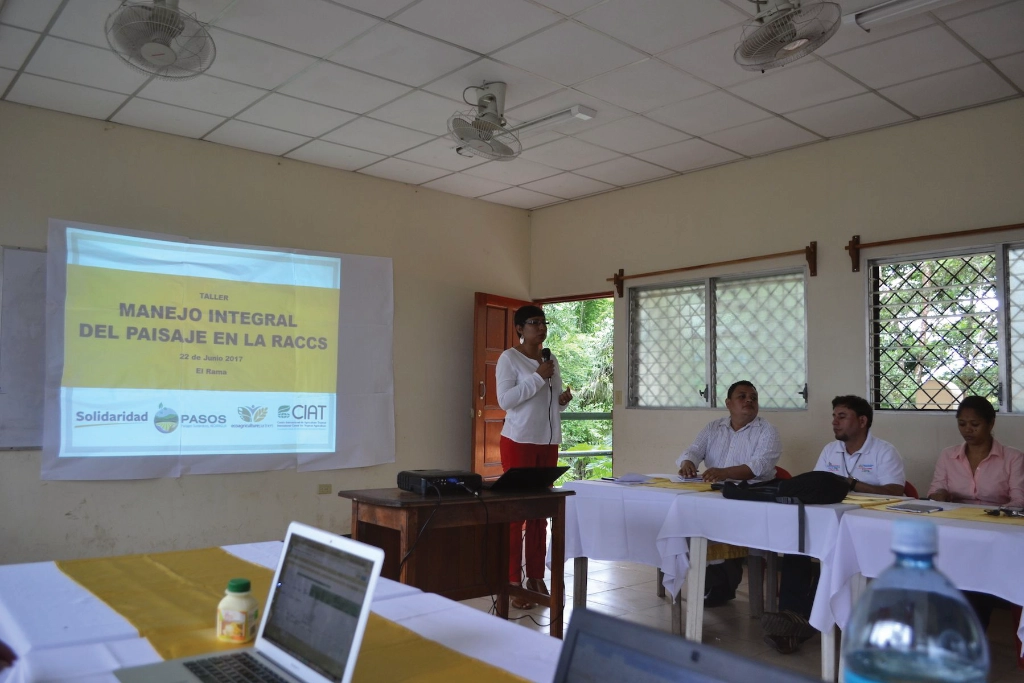
Last month, approximately 60 leaders from across Nicaragua gathered to catalyze Integrated Landscape Management in the Southern Caribbean Coast Autonomous Region (RACCS).
The workshops, in Bluefields and El Rama on June 20th and 22nd, respectively, served as the launch of the PASOS program in Nicaragua, a joint effort of Solidaridad, EcoAgriculture Partners, and the International Center for Tropical Agriculture (CIAT). PASOS, short for Paisajes Sostenibles (Sustainable Landscapes), is a platform that aims to strengthen the capacity of local leaders across Central America to define and implement their own strategies for sustainable development and landscape management in their region, and to facilitate dialogue and knowledge sharing between these regions.
The workshops provided the starting point for local actors to discuss the threats facing the region and their vision for the future, share activities and projects already being implemented in the region that could be built upon and coordinated, and generate ideas for new solutions.
The participants, representing diverse backgrounds and sectors, included members of cooperatives, cacao farmers, smallholder palm oil producers, technical specialists from palm oil companies, representatives of the regional government, central government institutions, local government, and civil society organizations, as well as students, professors, and researchers.
In the past 50 years the landscape has changed dramatically: expansion of agricultural areas and the introduction of new crops, the growth of urban areas, and the devastation caused by hurricanes Joan in 1988 and Mitch in 1998. Photo by Danbob wind.
A changing landscape
The RACCS, a region vast in size yet containing a relatively small percentage of the population, is located on the eastern part of Nicaragua. Although relatively small, the population is diverse, comprised of various indigenous groups that give it a rich cultural heritage. Agricultural activities include fishing, cattle raising, and production of palm, cacao, and annual crops. To travel between Bluefields, the location of the first workshop, and El Rama, the location of the second, one must take a boat along the Escondido River – driving is not an option.
Within the past 50 years the landscape has changed dramatically for a variety of reasons, including the expansion of agricultural areas and the introduction of new crops, the growth of urban areas, and the devastation caused by hurricane Joan in 1988 and Mitch in 1998. Due to these changes and the vulnerability of the region to the effects of climate change, now is the ideal moment to mobilize stakeholders to develop a coherent strategy and generate policies that allow for sustainable social and economic development while maintaining functioning ecosystems and preserving biodiversity.
The workshops were structured around various presentations that introduced concepts around Integrated Landscape Management by EcoAgriculture, sharing of experiences by CIAT and FADCANIC, an overview of policies supportive of Integrated Landscape Management by the Ministry of Environment and Natural Resources, and dialogue among the participants. Additionally, CIAT presented on the current status of land use and agricultural production in the region, while EcoAgriculture presented on the results of a landscape assessment conducted through stakeholder interviews. Participants enriched the discussion with their perceptions of the changes occurring in the region and explored possible solutions to advance the vision they have for their landscape.
As Maria Duran, Project Manager for Solidaridad in Nicaragua commented, “The RACCS landscape is closely linked to the identity of its inhabitants; we must work together to improve the livelihoods of its inhabitants as well as their future prospects. There are already plans and action, there is already a vision, we just need to facilitate the dialogue process and the exchange of experiences and knowledge to define new possibilities.”
Signals of Success from neighboring Honduras
In September of last year, Solidaridad launched PASOS-Honduras in the Northern Coastal Zone of the country. Using their work on RSPO certification with the Palm Oil sector as a driver, other stakeholders interested in the sustainability of the region and representing different sectors have become involved in the new PASOS initiative and took part in a Landscape Leadership course this past May. The most encouraging outcome of the process is the development of multi-sector working groups that are working to advance their own vision to improve management of the natural resources within their territory: a process that PASOS hopes to replicate in the RACCS.
Next steps for Nicaragua
The next step for PASOS-Nicaragua is a similar Intensive Landscape Leadership course this September for people from diverse backgrounds: civil society, industry, agriculture, local government, young emerging leaders, and others, so that with the support of professionals in the field, actors can organize themselves to establish a vision, strategy, and priorities for sustainable development and natural resource management relevant to the communities in the region.
Already, local actors have an idea for what they would like the process to entail. Silver Borge, of the non-profit FADCANIC, noted, “We should have a holistic vision, to see in many dimensions and directions. Integration must take into account local knowledge as well as external knowledge, so that they can complement each other. The vision of the project must be integrated and inclusive, for this reason I would like for it to involve more communal and territorial governments.”
“In the end Solidaridad’s objective is to facilitate dialogue and empower diverse stakeholders that live within the RACCS so that they themselves can define their own vision for sustainable management of the landscape, and provide the necessary tools to achieve it,” said Michaelyn Baur, Regional Director of Solidaridad Central America, Mexico, and the Caribbean.
More
Watch inspired PASOS-Honduras workshop participants sing.