
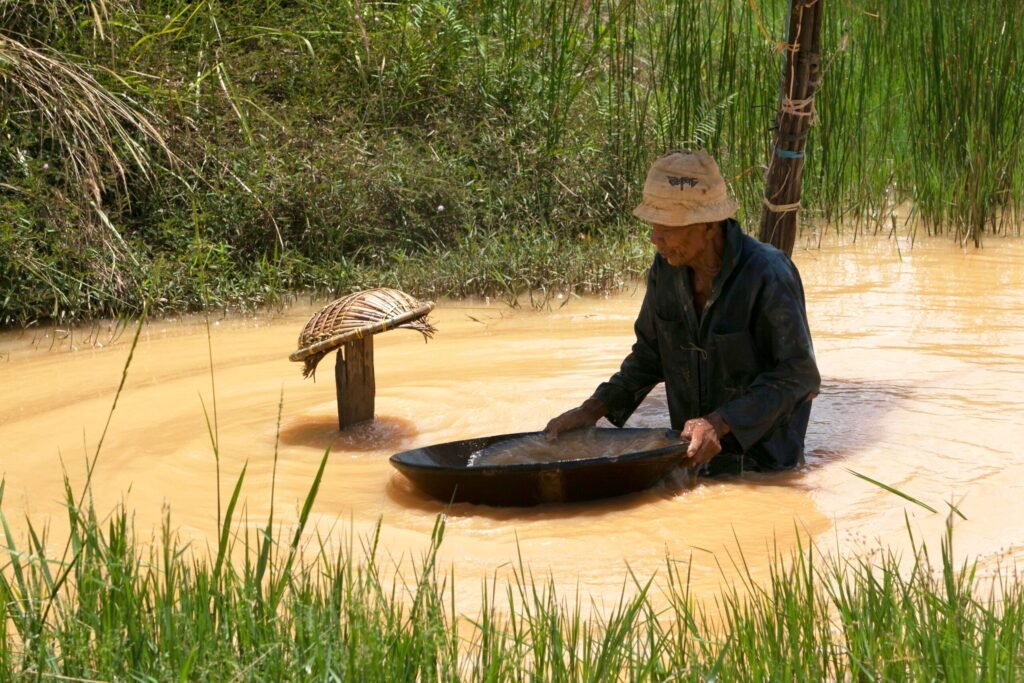
For communities across West Africa, artisanal and small-scale gold mining (ASGM) serves as both a livelihood lifeline and a source of environmental and economic conflict. Millions depend on it for their income, yet the practice often leaves behind scarred landscapes: deforested hillsides, polluted rivers, and mercury-tainted soils. For decades, policymakers have attempted to address these challenges through piecemeal regulations, often borrowing frameworks from large-scale mining that don’t fit the realities of small miners. The result has been an enduring cycle of informality, conflict, and environmental degradation.
In collaboration with Conservation International, the Conservation Strategy Fund, and the planetGOLD programme, EcoAgriculture Partners is helping strengthen the capacity of artisanal mining communities in 23 countries. In the first webinar, EcoAgriculture introduced the concept of Integrated Landscape Management, emphasizing the need for a landscape approach to address the challenges these communities face. The session also highlighted the importance of involving all stakeholders in decision-making. Subsequent webinars explored integrated landscape finance, landscape action planning, and inclusive landscape governance.
Why Mining Needs a Landscape Approach
Artisanal gold mining rarely occurs in isolation. Mining pits are often located near farms, rivers, and forests, with trade routes often cutting across protected areas. Mercury, still widely used in gold extraction, leaches into waterways, posing a threat to both biodiversity and human health. In Ghana, families describe how miners sometimes process ore in residential areas, exposing entire communities to mercury vapors. In Madagascar, seasonal miners migrate across fragile ecosystems, disrupting water flows and leaving behind patches of deforestation. In Côte d’Ivoire, communities named deforestation, polluted rivers, and mercury contamination as their most pressing concerns.
Traditional mining regulations rarely account for these realities. By focusing narrowly on technical compliance, they overlook the bigger picture: the competing demands of agriculture, conservation, water management, and community development. In places where mining is a major part of the landscape, it cannot be treated as separate from the broader systems of land use, livelihoods, and governance that a landscape approach seeks to address.
Ghana: Building Trust and Transparency
Ghana’s ASGM sector is extensive, but its governance suffers from outdated laws, centralized permitting, and poor policy coordination across mining, agriculture, and land management. Communities often face unsafe working conditions, environmental contamination, and weak enforcement.
Yet the challenge of centralized decision-making remains. Building stronger capacity for local governance is crucial to ensure that mining is not only better regulated but also more effectively integrated into the development priorities of rural communities.
PlanetGOLD aims to help reduce mercury use in Ghana’s artisanal and small-scale gold mining sector, which is estimated to consume up to 50 tonnes of mercury each year. Over the life of the project, it seeks to cut mercury use by as much as nine tonnes by strengthening the Ghanaian government’s capacity to meet its obligations under the Minamata Convention. The project also aims to support 100,000 people involved in ASGM by improving financial inclusion across the sector in Ghana.
Madagascar: Collective Action and Indigenous Voices
In Madagascar, the mining landscape is shaped by the mobility and remoteness of its locations. Seasonal miners move between rivers and upland sites, while communities grapple with mercury contamination, disrupted water systems, and forest loss. The country’s mining codes are outdated, resulting in fragmented governance that leaves miners and the environment vulnerable to hazardous chemicals.
PlanetGOLD’s approach emphasizes collective action and the inclusion of diverse voices. Social contracts between miners and other resource users are creating new forms of territorial unity, while Indigenous communities and women’s groups are gaining a greater presence in consultations. Mercury-free technologies are being piloted, and community coalitions are pressing larger mining companies to abandon mercury use altogether.
Côte d’Ivoire: Toward Formalization and Shared Vision
Côte d’Ivoire’s ASGM sector is marked by high environmental costs—deforestation, biodiversity loss, and contaminated rivers—while women, youth, and smallholder farmers are often excluded from decision-making. Coordination between ministries and local leaders is weak, resulting in fragmented and inconsistent governance.
PlanetGOLD’s work in the country is helping to turn cautious optimism into tangible progress. Training programs are equipping miners with knowledge of responsible sourcing standards and environmental best practices. Cooperatives are being formed to link mining to broader community development goals, ensuring that the benefits of mining extend beyond individual livelihoods. At the governance level, capacity-building efforts are helping ministries, local leaders, and communities coordinate their actions more effectively, creating a shared vision for sustainable landscapes.
Lessons Across Landscapes
Across Ghana, Madagascar, and Côte d’Ivoire, several lessons stand out. First, capacity is the engine of transformation. Whether it is negotiation training in Ghana, access to technology in Madagascar, or governance coordination in Côte d’Ivoire, investing in skills and institutional strength is the surest path to more resilient systems.
Second, inclusive participation is essential. Indigenous communities, women’s associations, and local leaders bring critical knowledge and legitimacy to the decision-making process. Their involvement is not optional—it is the foundation of governance that works.
The project also recognizes that mining alone cannot sustain families throughout the year. Efforts are underway to diversify incomes through sustainable farming, supported by training and access to finance. Capacity building is central: local teams are calling for more training, improved access to technology, and opportunities for cross-country exchange to share lessons and strengthen resilience.
Financing for implementing new policies and integrated governance remains a persistent challenge. Even when mercury-free technologies exist, miners often cannot afford them. Public–private partnerships, grants, and innovative cooperative models are crucial to scaling safer practices. Tools like the Mining Impact Calculator, introduced to the cohort by Conservation Strategy Fund’s sessions, can support communities in building a case for fair compensation, better governance, and more innovative land-use planning.
A Golden Future
The promise of Integrated Landscape Management is not simply cleaner mining—it is healthier ecosystems, empowered communities, and stronger economies. By linking artisanal mining to broader land-use governance and investing in capacity building at every level, EcoAgriculture Partners and PlanetGOLD are demonstrating that gold can be mined in ways that restore rather than degrade.
With the right training, tools, and governance frameworks, artisanal gold mining can become a force for renewal for both people and the planet.