
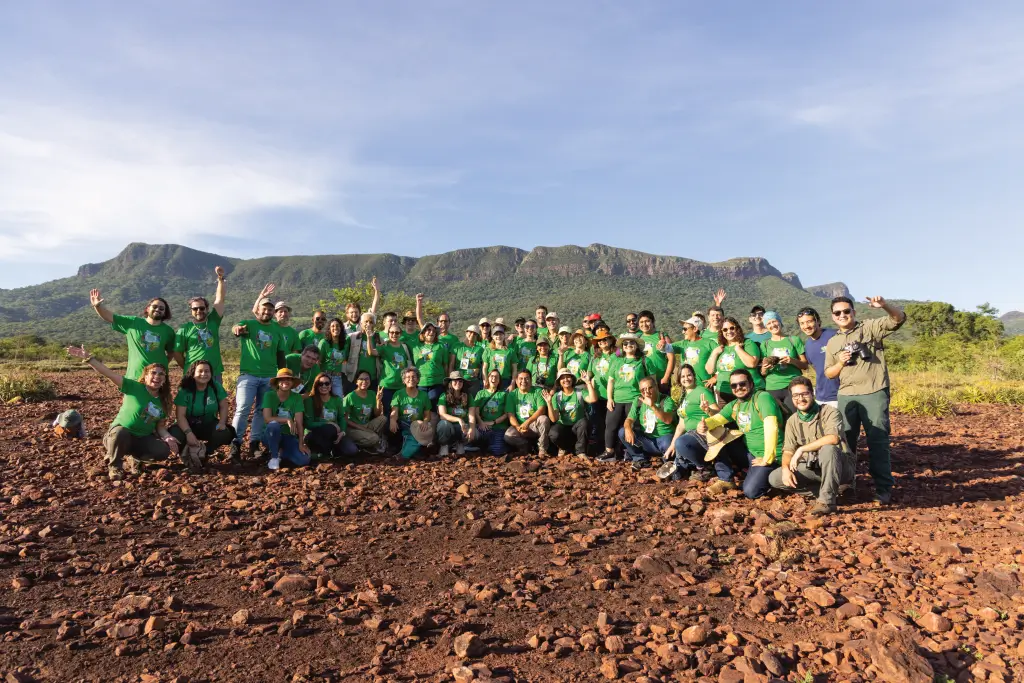
In March 2024, leaders from the Latin America Model Forest Network gathered in Corumbá, in Brazil’s Pantanal, for the opening workshop of the Forest Leaders for Integrated Landscape Management program. They came from ten countries and 15 landscapes, carrying different governance realities but a shared challenge: how to lead Model Forest processes in ways that can hold together people, nature, and long-term territorial resilience.
Pantanal was a fitting place to begin. As one of the world’s great wetlands, it is a landscape shaped by water, biodiversity, livelihoods, and constant negotiation between conservation and production. More often than not, production wins that negotiation, but not in Pantanal, where a delicate balance has held. It offers a living reminder of why Integrated Landscape Management is important.
Integrated Landscape Management, or ILM, is an approach that brings different actors together through partnerships and collaborative governance to manage land, livelihoods, and ecosystems in a more coordinated, inclusive, and long-term way. That idea is closely aligned with the Model Forest approach, which brings diverse stakeholders together around a shared vision for the sustainable future of a large landscape.
What began in Corumbá was not a one-off workshop but a regional process of learning, exchange, reflection, and action. Over two years, the program connected leadership already present across 15 Model Forests and gave it stronger structure through training, peer learning, applied research, seed grants, and practical opportunities to act.
Beginning in Pantanal
The opening workshop gave participants a chance to step out of the pressures of daily work and into a wider regional conversation. For some, it was also the first time they encountered ILM as a practical framework for territorial leadership.
That mattered.
As one leader from Peru’s Pichanaki Model Forest reflected, “learning about ILM marked a before and after for our Model Forest.” Although the team already understood governance as a pillar of territorial action, he said, ILM showed them how to do that work in a more organized, systematic, and methodological way.
He summed it up in a phrase that stayed with the process: nos dio ordenamiento: It gave us structure.
In territories facing environmental pressure, that kind of structure is vital. It helps turn concern into shared direction and makes leadership more intentional in practice. From the start, the program recognized that participants were not arriving empty-handed. These were leaders with deep local knowledge. What the process offered was a way to learn across territories and build a shared language for work that had often been carried forward in isolation.
Learning, Exchange, and Mentorship
After Pantanal, the program continued as a sustained process rather than a single convening. Leaders moved through training, exchanges, and mentoring support designed to help them apply ideas directly in their own territories. Over 24 months, leaders moved through virtual training, exchanges, and mentoring support designed to help them apply ideas directly in their own territories.
This process was crucial because landscape leadership cannot be built through theory alone. Participants revisited their theories of change, tested ideas at home, and returned with sharper questions about participation, dialogue, and inclusive governance. Leaders brought real territorial dilemmas into the space and left with practical ways to act on them.
Learning Modules: Building a Shared Foundation
To support that kind of practical reflection, the program’s training modules became one of its core pillars. Developed through a participatory process with Model Forest leaders, they focused on five priority themes: fire governance, public policy, gender, strategic communication, and conflict management in the context of ILM. The modules include theory handouts and facilitation guidance for use across different landscape contexts. Together, they help leaders convene stakeholders, guide dialogue, and strengthen inclusive governance and decision-making.
Research Fellows: Deepening the Questions That Matter
Early in the initiative, EcoAg set out to capture the practical and innovative lessons emerging from lived landscape experience. Five research fellows were selected to explore the questions that mattered most in their territories and the Latin American Model Forest Network. Their projects focused on themes including Indigenous women’s leadership, climate resilience, youth engagement, multilevel governance, leadership transitions, and lived experience of landscape leadership.
Their work was not separate from the rest of the initiative. It grew out of the same regional dialogue and territorial concerns, helping turn lived experience into insight that could travel across the region.
“The Forest Leaders for ILM program was important for consolidating the Pantanal Model Landscape,” said Luciana Vicente. “The experience brought technical tools, while also reinforcing relationships and collective learning. For us, it represented an essential step in coordinating more integrated actions and building a more resilient territory.”
Shaped through mentorship and peer exchange, the fellows’ work both drew from the emerging Community of Practice and contributed back to it.
Another important strand of the initiative was the systematization of the seed grants and the projects they supported. That work helped document the impacts of catalytic funding for governance activities and for investing in the ILM process itself, not only in project delivery. It also reinforced an important lesson: across many Model Forests, progress was often most visible in relationships, participation, and shared understanding, even when formal monitoring and learning systems were still catching up.
A Community of Practice Rooted in the Territories
One of the program’s most important outcomes was the emergence of a regional Community of Practice, which grew organically from the course, the exchanges, and the relationships built along the way. As participants returned with new ideas and early experiments from their territories, they found that many of their challenges were shared: how to strengthen participation, navigate competing interests, sustain leadership, and move from dialogue to action.
This foundation will enable the community to continue thriving long after the project formally concludes, providing an ongoing forum for exchange and cross-learning among Model Forests.
Seed Grants: Turning Learning Into Action
If the workshops and exchanges built shared understanding, the seed grants helped turn that understanding into action.
With support from Natural Resources Canada, EcoAgriculture Partners funded two cycles of 15 seed grants of $5,000 each across participating landscapes. The projects were diverse, but many focused on governance, territorial planning, communications, and shared visioning.
In Abancay, the grants supported engagement across multiple levels of government. In Chocó Andino, they supported work on landscape boundaries. In Puerto Rico and Pichanaki, they helped reactivate dialogue and strengthen governance.
Franciane Santana of Brazil’s Amazonas Tapajós Model Forest described what that support made possible: “The seed grants supported our first meeting about ILM and boosted our enthusiasm to integrate communities, conservation practices, and rural producers’ livelihoods around common objectives.”
These grants created conditions for dialogue, alignment, and more coherent territorial action, with each landscape moving from a shared framework toward its own priorities.
Why the Design Worked
One of the program’s strengths was that it was never built as a set of disconnected activities. The workshops, training, research, seed grants, and mentorship reinforced one another.
That integration reflected a clear understanding of how change happens in landscapes: not through isolated interventions, but through a process that combines shared learning, practical experience, exchange, and accompaniment.
At the heart of the design was a simple conviction: the people living in landscapes already hold much of the knowledge needed to address the challenges they face. The program’s role was not to import leadership, but to strengthen, connect, and support the leadership that was already there.