
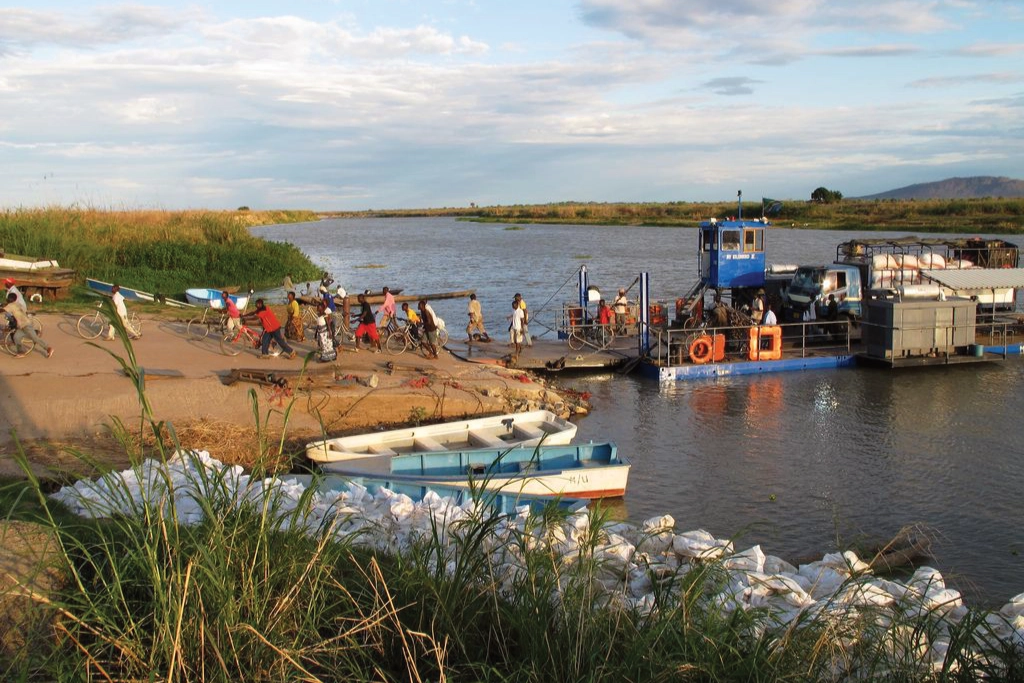
Translating landscape ambitions into investible action items is crucial to preserving the Kilombero Valley landscape and promoting sustainable growth in agriculture.
EcoAgriculture Partners Director of Policy and Markets Seth Shames recently traveled to Ifakara, Tanzania to co-host a workshop titled Achieving SDGs at a landscape scale: Modeling a sustainable future and creating an investment plan. The workshop, which took place March 5th to March 8th, and was hosted by The African Wildlife Foundation in collaboration with the Netherlands Environmental Assessment Agency (PbL), IUCN Netherlands, and EcoAgriculture Partners, sought to initiate a process of collaboration in the Kilombero landscape which will model development scenarios to 2030; use these models to identify a plan of action that could achieve a more sustainable future; and translate these actions into financeable investments. In attendance at the workshop were members of local government, private sector representatives, officials from the African Wildlife Federation, various NGOs working within the landscape, as well as Stephen Nindi of the National Land Use Planning Commission of Tanzania.
A 2030 Vision for Kilombero
The Kilombero Valley landscape, once a haven for wildlife and biodiversity, has undergone a transformation to a landscape heavily dominated by agricultural plantations and subsistence farming. This transformation, largely due to increased foreign investment in agribusiness and infrastructure in the landscape, has resulted in a sharp decline of biodiversity within the landscape. This decline in biodiversity has resulted in the Kilombero landscape becoming a site of great tension between the Tanzanian government, foreign private enterprise, smallholders in the landscape, and conservationists. The explicit emphasis on agricultural and economic growth “at all costs’ within the landscape has greatly compromised the ability of the landscape to deliver crucial ecosystem services in addition to the decline in wildlife in the area.
The current trajectory of agricultural development within the landscape is unsustainable, but many initiatives in the region have pointed to the viability of the Sustainable Development Goals (SDGs) as a model for sustainable agricultural and economic growth with an emphasis on conservation. Expanding on this concept of applying the SDG framework within the Kilombero, the workshop opened with an introduction to Integrated Landscape Management as a potential approach to achieving synergies between development, conservation, and agricultural production goals within the landscape. Additionally, presenters highlighted a preliminary model of what the Kilombero landscape will look like in 2030 under a ‘Business as Usual’ scenario. The model catalyzed discussions among participants over what key actions need to be taken within the landscape to achieve a more sustainable future as a whole. Participants also discussed what adjustments would need to be made for the model to better suit their ambitions for the landscape.
Designing priority actions as investments
After discussions debating priority actions that need to be taken for a sustainable Kilombero Valley landscape, the workshop shifted emphasis to designing priority actions as investments to acquire financing for sustainable development. To do this, Seth Shames and co-presenter Jan Willem den Besten introduced participants to the Landscape Investment and Finance Toolkit (LIFT). According to Shames, the toolkit functions to make investment more accessible by “providing comprehensive guidance to landscape partnerships which are working to attract investment that is supportive of their vision.”
Translating landscape ambitions into investments that can be financed is crucial to achieving a sustainable future for the Kilombero Valley. The landscape, which has long been a site of collision between conflicting interests, now has an opportunity for long term increases in economic growth and agricultural production that also maintains and preserves the Kilombero’s rich ecosystem. By encouraging investment within the landscape that is in line with these priorities, the stakeholders in the Kilombero landscapes can better negotiate their own priorities with the ecological needs of the landscape as a whole.
At the conclusion of the workshop, participants representing various sectors involved in the planning and use of resources within the landscapes agreed that the best way to proceed is to create a Multi-Stakeholder Platform (MSP) to improve negotiation and governance among actors within the landscape as well as to begin to establish an action plan for sustainable development within the landscape. This crucial first step is one in the direction of casting aside a long history of inequitable priorities within the Kilombero landscape and hopefully marks the beginning of a focused effort to both preserve biodiversity and advance sustainable sustainable investment within the landscape.
Featured photo by David Davies on Flickr.