
In this Q&A, project manager Kata Young explores her personal and professional history with agroecology, and the growth of the agroecology movement.
On March 27th, 2018, EcoAgriculture Partners and the Food and Agriculture Organization of the United Nations (FAO) hosted an event in our series of Washington, DC roundtables on policy for integrated agricultural landscape management at the FAO North America Headquarters Office in Washington, DC. Titled Agroecology in Sustainable Landscapes, the roundtable discussion explored where agroecology fits in within the idea of Integrated Landscape Management, and the measures that need to be taken to ensure success.
As a part of #AgroecologyWeek on the EcoAgriculture blog, Brett Jacobson sat down for a more in-depth conversation with EcoAgriculture Partners’ speaker at the roundtable, Kata Young. She shares her perspective on the state of agroecology today and the work of helping agroecology take root at scale.
Brett Jacobson: At the roundtable the speakers touched on how agroecology occupies a position at the nexus of intersecting disciplines. Marcia DeLonge, one of your fellow speakers at the roundtable mentioned how agroecology can describe “the science, the practice, and the movement.” What is agroecology to you?
Kata Young: Agroecology can be described as agricultural production based on ecological principles. It is highly complex and dynamic, similar to the way natural ecosystems inherently function. The central challenge for agroecology is to integrate these methods with the complexities of human culture and historical context to address the challenges that we are seeing and will continue to see from the effects of climate change.
BJ: How has your background working on and studying agroecological practices at the farm and community level shaped your sense of the global challenge of building sustainable food systems? How has your understanding of that challenge changed over time?
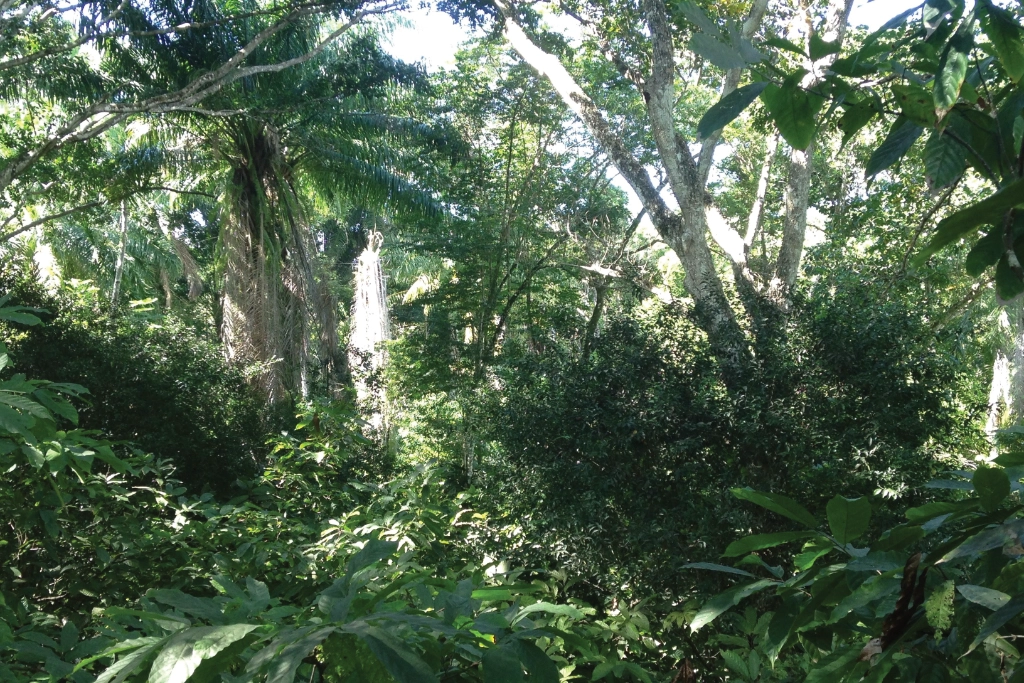
KY: I got my start working with agroecology at the farm level, specifically the microfarm level. I first worked on organic farms in Mexico for a year, working specifically with annual production of subsistence crops for personal and family consumption, then later developed experience in an agroforestry research farm in Belize, then with a coffee and macadamia nut cooperative in Guatemala, and later focused on ethnobotanical horticulture and agroforestry diversification in Nicaragua for three years. Over a period of about three to four years, it became very clear that agroecology provides a way to utilize both natural and human resources most efficiently. While it is very knowledge intensive, agroecology also provides an avenue for dignity and wisdom in farming practices that have been used throughout history. Over fourteen years, though my work transformed from working at microscale home level production to working with farmer field schools, within farmers groups, and looking at a larger scale at the community and regional levels, I have seen first hand how the needs of people aren’t often reflected in the policies that are in place, nor nuanced in the interventions that are offered.
Moreover, I found that when looking at the landscape level where we were working, there was often a hard stop between field and forest. This hard stop resulted in tensions between farmers and land managers working to produce materials and food, for both themselves and for market, and land managers looking to protect biodiversity. Specifically, a tension I often observed was one between prohibiting people who had lived within the landscape for generations from accessing natural resources that had previously always been accessible to them, and a dearth of effectively building the capacity, knowledge, and expertise of how to better manage the resources that exist. This tension often results from the research and policy priorities aimed at addressing the need for biodiversity conservation within landscapes, but not addressing an even greater need to transition the management of land uses between highly intensive land uses for humans and native habitats for wildlife.
Over the last fourteen years I’ve been building up these scales from family, to communities, to farmer groups, and my interests have evolved to examine perennial systems of agroecology, specifically agroforestry, as both a productive, human-managed system that has high value for personal consumption and market opportunities, in addition to protecting many of the natural ecosystem processes needed for the conservation of biodiversity. After grounding my understanding in the sociological basis of the need for food security and food sovereignty within landscapes, and later integrating that understanding with biodiversity conservation needs and interests, it became abundantly clear that our policies are not addressing needs on the ground for stakeholders in the landscape. Additionally, the private sector, who often has the greatest capacity to mobilize sources of funding, were often missing from the negotiation table beyond the production of commodities. Since joining EcoAgriculture Partners, my goal has been to support multi-stakeholder platforms to better negotiate land management priorities within landscapes.
BJ: At the roundtable you mentioned that a major challenge to transitioning to successful agroecological systems is the question of how to scale. It can be easy to point to stories at a farm level where agroecological approaches have been successful in managing multiple priorities with intersecting interests, but much more difficult to find examples of success on a larger scale. How can approaches like ILM help address this question of scale?
KY: I think the opportunity that ILM provides for scaling is in providing a framework and a common language around which stakeholders from multiple sectors with differing levels of expertise can develop a shared understanding of the landscape and begin to better negotiate their interests and ambitions for the landscape. Without a shared language, there can’t be any cohesive way forward to address these “wicked problems” that we are facing on a global scale.
BJ: At the roundtable, some of the speakers mentioned how the term “agroecology” was long considered taboo, or understood as fundamentally at odds with traditional methodologies for agricultural development. How accepted are agroecological approaches now? What other methodological barriers to progress do you see at the intersection of food security, sustainable agriculture, and conservation?
KY: Certainly over the last ten years, the word “agroecology” and other words that reference sustainable agricultural production have become more prominent at the highest levels of international organizations working in agricultural development and food security. This prevalence is very much a reflection of the groundswell stemming from grassroots efforts that are working with farmers and researchers to find best practices that integrates traditional knowledge with modern technological advances.
The extent to which agroecology is accepted very much depends on who you talk to. Agroecology has been developed by farmers themselves throughout human history. Following the Green Revolution, there was a significant cultural clash between technological tools for agricultural production to address food security and traditional methods used by farmers around the world. After the Green Revolution, we saw a real resurgence of interest in agroecological methods, particularly among NGOs and the civic sector, to counterbalance some of the negative effects of the oversimplification of food systems during the Green Revolution.
In addition, the perception of agroecology as at odds with the dominant methodologies for agricultural development largely emerged due to the nature of complexity in agroecology as a natural opposite to simplified, industrialized agricultural production. But over the years, as more investment has been made in research, and the science of agroecology has been reviewed and become more nuanced, we see a variety of different types and scales of agricultural producers adopting the language of agroecologists to identify ways in which their businesses and initiatives can provide the services that are still needed. Simultaneously, some agroecologists have become more tolerant of large scale producers, opting to view them as potential allies rather than inherently at odds with their agenda for sustainable agricultural development.
In terms of barriers to progress, at the farm and farmer group level there needs to be investment in agricultural extension, ongoing adult training and capacity building that uses the information and resources from academia to ensure that agroecological practices being used within landscapes are integrated with traditional systems of knowledge and best practices identified by contemporary research. In addition to this, market development to provide opportunities for high value, lesser known species, where cooperative models for achieving an economy of scale can provide a quantity of products at a price that’s fair to the farmer but also attractive to the consumer is essential. This type of market development must be combined with an institutional paradigm shift that redistributes the power away from the market itself, and puts it back in the hands of the people it is designed to serve, recognizing the inherent dignity and social power of both the producer and the consumer in the food system. This is essential because efforts to create a more sustainable and equitable food system must meet a growing informed consumer base that seeks to put their purchasing power into the hands of producers whose values and methods contribute to actively regenerating our ailing planet.