
When faced with an enormous challenge, sometimes the first step is the hardest to take.
In East and Southeast Asia, the production of key commodities like coffee, tea, maize and shrimp has involved the rapid conversion of forests, waterways and coastlines. While the private sector and NGOs, in partnership with local decision makers, have piloted projects to address environmental damage caused by agricultural production, governments in the region are well poised to create standards that encourage land users to manage production areas to achieve environmental, economic, and social objectives. However, long standing structural restraints and the lasting consequences of massive land use changes can make it difficult to identify a clear political path for environmental sustainability.
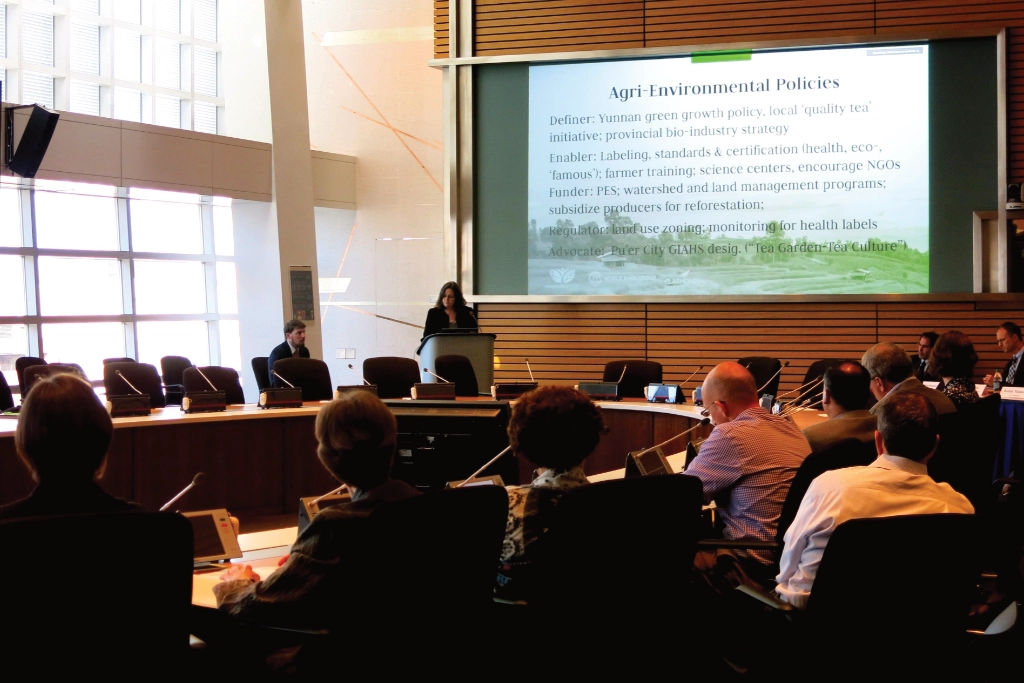
On September 15th, leading experts in agricultural economies and commodity markets joined forces to launch new research, published in the book Steps Toward Green, on multi-faceted policy actions designed to push structural changes to how governments manage natural resources tied to agricultural landscapes. A panel of speakers from EcoAgriculture Partners, The World Bank, Conservation International, the International Finance Corporation, and One Campaign discussed effective and practical measures which governments could take to reduce the environmental footprint of commodity agriculture.
Roadblocks to comprehensive changes in land management
There are many barriers to enacting the agri-environmental policies, and associated institutional supports, necessary for correcting harmful production practices. Beyond addressing the omnipresent health and social consequences of environmental damage caused by land conversion, including increased frequency of forest fires, air and water pollution, reduced soil quality and changes in local climate regimes, developing countries are generally hamstrung by structural shortcomings, such as:
- Conflicting land tenure laws;
- Insufficient resources for the enforcement of environmental regulations;
- Inconsistencies between provinces in environmental protections and land classifications;
- Limited resources for the development of land use planning tools and specialized training programs for land use managers.
Under the current paradigm, economic growth and environmental protections are perceived to be competing interests. The real challenge for policy makers is to find synergies and reduce trade-offs between these two goals using targeted policy actions that produce outcomes beneficial to the environment, the economy and communities.
Policy can scale up sustainability in agriculture
Among the recommendations put forth by the authors of Steps Toward Green is to support and scale existing projects led by the private sector and civil society that build environmental stewardship into production modes. Steps Toward Green co-author Steven M. Jaffee noted, “There is a lot of work going on to document and draw lessons from private and civil society initiatives that are gaining traction, yet scaling-up their impacts is a problem.”
Across the board, the experts agreed that East and Southeast Asia are at an agricultural turning point: either they commit to export agriculture at all costs to maintain economic growth, or they revise current modes of production to create multifunctional landscapes that provide health and wealth for rural people and sustainable economic growth for the country.
Guest panelist John Buchanan of Conservation International reflected on the potential of Integrated Land Management to address many of the interconnected issues of agriculture, conservation and development at play in the region: “At Conservation International we are trying to break down this distinction of development on one hand and conservation on the other… We believe these are linked and are flipped sides of the same coin. That leads us towards integrated approaches that combine conservation activities and sustainable production activities in a variety of sectors and really engage governments, communities and civil society in a common vision.”
Agricultural Green Growth as the path forward
The panel revealed a disconnect between private and civil-sector led initiatives for motivating sustainability practices and institutional support.
Co-author Scherr commented, “What we have seen in much of East and Southeast Asia has been an emphasis on voluntary activity from the private sector – a lot of sustainable supply chain work – but often without the framework of government policy to make them effective at scale.”
The book posits Agriculture Green Growth as an investment framework that supports Integrated Land Management, a collaborative approach accounts for the interests of various stakeholder groups and multiple land use objectives for in determining how to sustain both food production and ecosystem services within a commodity landscape.
National governments can push environmental stewardship by taking on a coordinated strategy to not only talk about sustainability, but empower lower managing bodies to enact environmental policies. Governments can do this by: defining standards; advocating for the benefits of best land use practices; creating and enforcing regulations that are consistent across provinces; providing opportunities for specialized training and research in land management; directing and allocating finances for organizational and technical costs of embedding sustainability into commodity supply chains.
Cases look at challenges and opportunities
A diverse array of stories emerging from a call for integrated land management projects illuminated various entry points for government to augment efforts to address agri-environmental issues. Some examples of successful sustainability initiatives, based in commodity production, came from local governmental movements, private sector led initiatives and civil society. The detailed analysis of six cases demonstrated the challenges for policy change, and the ability of proactive strategies to not only significantly prevent degradation of key natural resources, but also to generate revenue for communities and companies.
Co-author Kedar Mankad explains, “Now that we have this idea of different roles of government, what do these actually mean and how can we make specific recommendations to individual places? The main barrier to move toward Agriculture Green Growth is the lack of alignment of local, regional and national entities in specific context. When we talk about ‘enabling environment’ we are talking about national and local players not talking to each other.” The research was a preliminary attempt to understand how governments should design and apply strategies to make environmental sustainability a priority in agricultural development. Although more investigation is needed to determine specific actions, based on the nuanced circumstances of each locality, a common theme revealed itself as a barrier to effective agri-environmental policy: the lack of an “enabling environment.”
Steps Toward Green provides a knowledge platform, based on the Asian experience, for coordinating collaboration around integrated land management. In their outlook, the panelists were optimistic in the benefits of this research to promote environmental stewardship in Asia and similar emerging agricultural economies in Africa.
Read the full Text
Download the full text of Steps Toward Green.
Limited on time?
The research and findings of Steps Toward Green are summarized in the following briefs:
- Greening Commodity Agriculture: policy brief providing an overview of the book’s recommendations to policy makers.
- Insights from six commodity landscapes: 2-page briefs on each case study assessed in the book.