
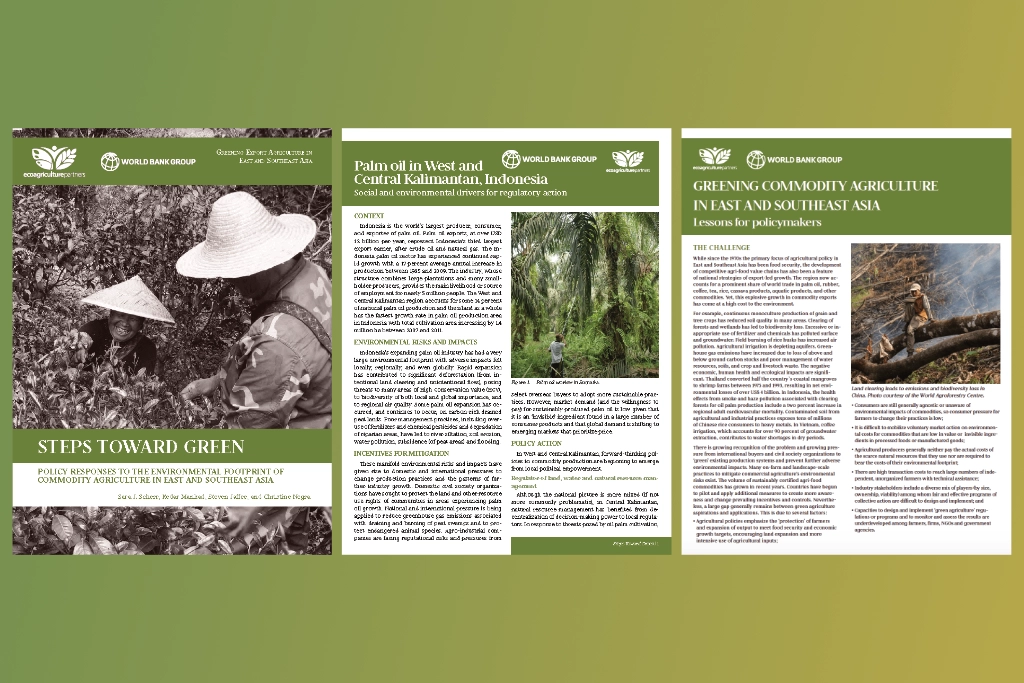
A new book from EcoAgriculture and the World Bank will help policymakers make agricultural sustainability a national reality
New insight from research across six countries in East and Southeast Asia brings needed clarity to the hazy agricultural and environmental policy atmosphere of the region. A book synthesizing the work, published this September by EcoAgriculture Partners and The World Bank, spells out strategies for East and Southeast Asian policymakers looking to “green” the production of agricultural export commodities.
Over recent decades, the emerging economies of East and Southeast Asia have come to play a prominent role in the international trade of palm oil, rubber, coffee, tea, rice, bananas, shrimp, and other commodities. While contributing to economic growth, this expanded trade often came at the expense of the environment, being a major contributor to deforestation, biodiversity loss, land and water resource degradation, and greenhouse gas emissions. These outcomes are not inevitable. What the authors call “Agricultural Green Growth” presents a framework for policymakers to redirect the pathway of agricultural development in ways that better sustain economies and livelihoods, while also securing the benefits of healthy ecosystems.
Co-author Sara Scherr, President and CEO of EcoAgriculture Partners, says, “The Agricultural Green Growth framework positions agriculture as a principal engine for human and economic development, encouraging society to manage agricultural landscapes to provide more than just food and industrial raw materials and weave resource conservation, efficiency, and sustainability into the core logic of land-based investments.”
A multi-dimensional policy approach to prevent environmental damage, while promoting agricultural growth
In the book, Steps Toward Green: Greening Commodity Agriculture in East and Southeast Asia, the authors, Scherr, Steven Jaffee, Kedar Mankad and Christine Negra, with input from Clarmondial on the landscape case studies, recommend a set of complementary roles for national governments to play to better align agricultural growth with environmental protection. In addition to defining policy goals that embrace sustainable development goals, and setting regulations, governments at national and local levels can mobilize change on the ground by co-funding stewardship investments, enabling private and civic solutions, and advocating for public support of the Agricultural Green Growth agenda.
Steven Jaffee, Lead Agricultural Economist at the World Bank, explains, “This represents a shift from adopting reactive, rehabilitative measures – typically after heavy human health, livelihood, ecosystem, and other costs have already been incurred – to taking a strategic and multi-dimensional approach to managing the environmental risks to and from agriculture.”
The book analyzes policy experience and innovations in six important commodity landscapes in China, Viet Nam, Indonesia, Thailand, and Philippines to highlight challenges and provide recommended actions for policymakers. Governments in these countries at national and local levels are just beginning to institutionalize environmental stewardship. The authors explain how these developments can be catalysts for further political mobilization.
For example, in Viet Nam’s Central Highland provinces, more sustainable soil, water, and post-harvest management practices for coffee have been effectively demonstrated through public-private collaborative programs, yet fewer than one-fourth of growers have adopted them. To influence the prevailing incentives and scale up progress on the ground, a new program is linking the provision of long term finance for coffee replanting to sustainability measures which farmers will need and will be supported to adopt. Complementary efforts are involving multiple stakeholders to address the wider natural resource management challenges in the watersheds where coffee and other tree crops are grown, yet also feature industrial and urban residential expansion.
Scherr suggests, “While many on-farm and landscape practices to mitigate environmental risks exist, there is generally a large gap between green agricultural aspirations and their applications. In this book, we show the wealth of new tools that policymakers can use to close that gap and make green economies a reality.”
Policies need to combine value chain approaches, including product certification, with spatial approaches that engage all major land managers – farmers, businesses, governments, conservation organizations – in negotiating landscape actions that address their diverse products and need for ecosystem services. More investment is needed to strengthen organizational capacity, data and knowledge systems to support agricultural green growth.
Downloading the Book
Download your copy of the new book, Steps Toward Green, today. The full text is available here.