Financing Strategies for Integrated Landscape Investment: Case Study of Atlantic Forest, Brazil
Region of Focus
Topics
Overview
Top five in biodiversity
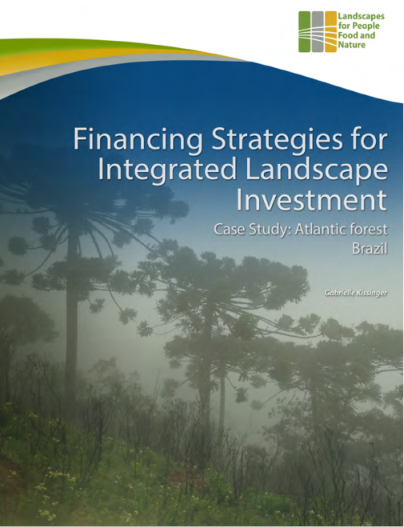
According to UNESCO, Brazil’s Atlantic Forest (Mata Atlantica) is one of the world’s five most important biodiversity hotspots. This forest, once 130 million hectares along Brazil’s coast, is now just 50 ha of isolated fragments. The region is now home to 60 percent of Brazil’s population, 70 percent of the country’s economic activity, and a significant amount of its agricultural production.
Payments for restoration
Because of the extent of land degradation and fragmentation, and the crucial services the forest provides, Brazil is attempting to restore and revitalize this unique landscape. The Atlantic Forest Restoration Pact (PACT) is part of that attempt. Established in 2009, PACT is the culmination of two decades of growing interest in restoring the forest. Through PACT, NGOs, research institutions, local governments, and private businesses are working together to restore 20 million ha of degraded and low productivity forest by 2050. The goal is a big one, but PACT is growing quickly to meet the challenge, with more than 170 initiatives registered so far in eight states.
Media Type
Language
Published
1 April 2014
Authored by
Gabrielle Kissinger
License
Creative Commons - BY - NC - ND
License
License
Related Resources
Financing Strategies for Integrated Landscape Investment: Case Study of Lake Naivasha, Kenya
Financing Strategies for Integrated Landscape Investment: Case Study of Atlantic Forest, Brazil
Financing Strategies for Integrated Landscape Investment – Synthesis Report
Financing Strategies for Integrated Landscape Investment: Integrated Landscape Initiative Analysis
Financing Strategies for Integrated Landscape Investment: Financial Institution Case Studies