
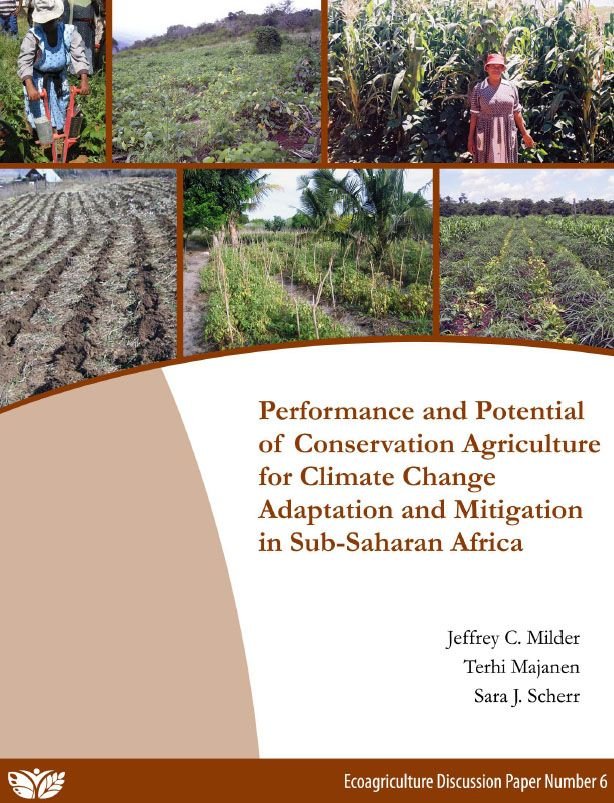
Performance and Potential of Conservation Agriculture for Climate Change Adaptation and Mitigation in Sub-Saharan Africa
Region of Focus
Overview
What is conservation agriculture?
Conservation agriculture (CA) is a farming approach that fosters natural ecological processes to increase agricultural yields and sustainability by minimizing soil disturbance, maintaining permanent soil cover, and diversifying crop rotations.
CA has already been demonstrated to benefit large-scale and small-scale farmers in diverse contexts by increasing soil fertility, reducing input costs, saving labor and fuel, conserving water, preventing erosion, and increasing farm profitability.
In support of climate change mitigation
This Discussion Paper examines how CA might also support climate change adaptation and mitigation in the context of smallholder agriculture in sub-Saharan Africa. It also defines and analyzes a broader approach to CA—including natural resource management and support for human and social capital at the farm, village, and landscape scales—that may increase synergies between food production, ecosystem services, and climate change adaptation.
The paper concludes by suggesting ways in which new policy priorities and climate finance sources may support the scaling-up of CA in appropriate contexts throughout sub-Saharan Africa, following the mainstreaming of CA that occurred in the Americas in prior decades.
Media Type
Language
Published
1 November 2011
Authored by
Majanen Terhi, Milder C. Jeffrey, Scherr Sara
License
Copyright © 2011 Ecoagriculture Partners All rights reserved. Sections of this report may be reproduced without the express permission of but with acknowledgment to EcoAgriculture Partners. Contact info@ecoagriculture.org.
License
License