
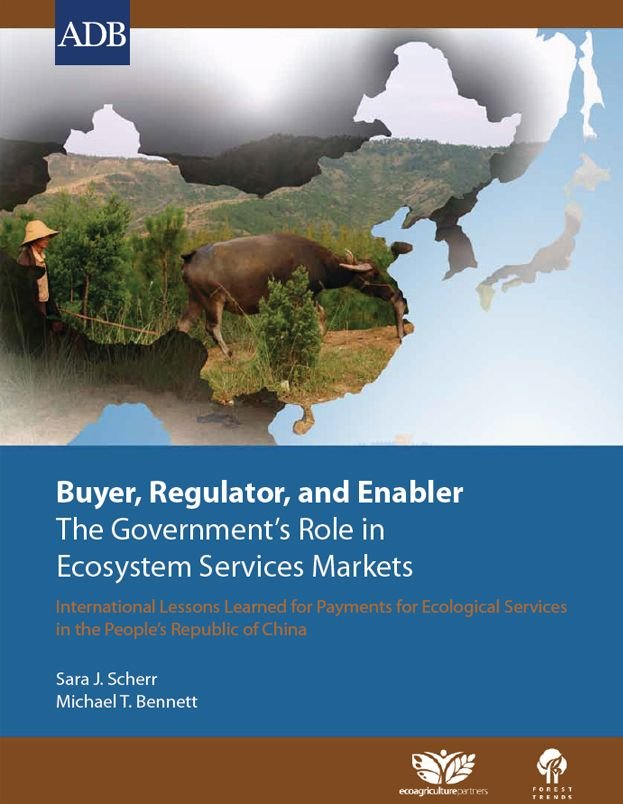
Buyer, Regulator, and Enabler – The Government’s Role in Ecosystem Services Markets
Region of Focus
Topics
Overview
Economic growth in China
The People’s Republic of China (PRC) is at an exciting stage in the development of its national environmental policy framework. The fast-paced economic growth of the past 3 decades has unfortunately also greatly multiplied the environmental challenges faced by policy makers at all levels of government, increasing pressures on fragile ecosystems, creating a range of new pollution and environmental safety issues, and further straining the country’s already limited per capita natural resource base.
At the same time, economic growth has also created opportunities, including giving the government the capacity to improve its ability to monitor and enforce existing environmental laws, and to fund new environmental initiatives and policies.
Policy makers have been experimenting with new approaches to environmental management, resulting in a wide range of policy and program innovations, many under the broad heading of “eco-compensation.” Many of these incorporate, or provide a framework for, market-based approaches to environmental policy, and in particular for payments for ecological services (PES).
Payments for ecological services
PES is gaining traction internationally as a valuable new approach to conservation that uses direct payments, either in cash or other forms of compensation, from ecosystem services beneficiaries (e.g., private businesses, communities and society as a whole) to land stewards (i.e., those who can influence the provision of ecosystem services) to encourage ecosystem conservation and restoration.
In general, four types of ‘market’ or ‘market-like’ instruments exist for ecosystem services provision:
- Private payments for private benefits (that may or may not have public benefits);
- Public payments (on behalf of the public interest) for public benefits;
- Private payments motivated by cap-and-trade or floor-and-trade regulatory systems; and
- Eco-certification where ecosystem services provision is included as a characteristic of a standard market good (e.g., “green” and organic agricultural products in the PRC).
In comparison to PES, the Chinese term “eco-compensation” is broader, encompassing PES-like policies, as well as a range of other policies and programs types, both with and without market-based element. The PRC has the opportunity to both benefit from and provide innovative examples for international developments in PES. In particular, the PRC’s experience highlights an important point often implicitly overlooked in the international discourse on ecosystem service markets and PES: the central role of the public sector.
Media Type
Language
Published
15 April 2011
Authored by
Bennett T. Michael, Scherr Sara
License
© 2011 Asian Development Bank
License
License