
Building Community Assets and Capacities for Adaptive Management
Region of Focus
Overview
In pursuit of its mission to relieve hunger and promote food security where food insecurity and poverty prevail, the United Nations’ World Food Programme (WFP) recognizes climate change as an increasingly important multiplier of food insecurity.
Responding to the challenges of climate change
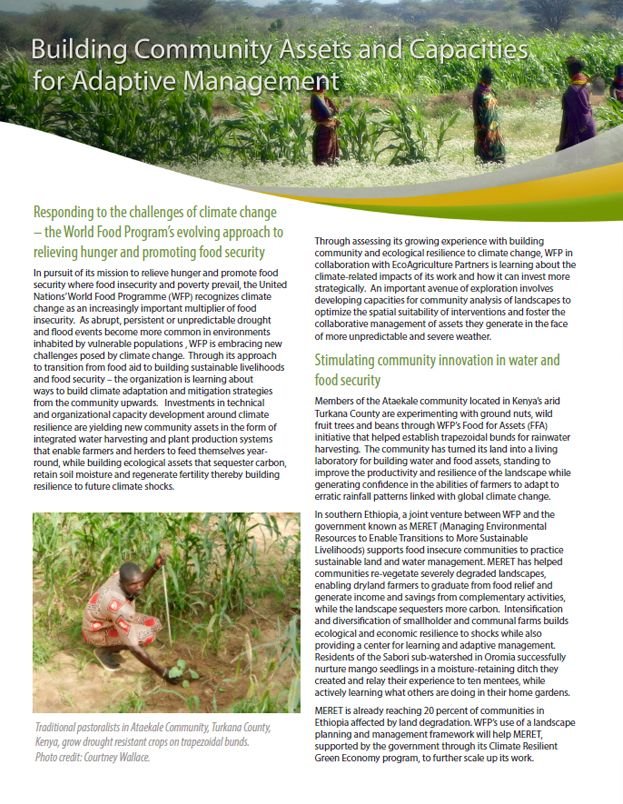
Abrupt, persistent, and unpredictable drought and flood events have become more common in East Africa. Many of the communities here are vulnerable due to their dependence on the land, particularly agriculture, for their livelihoods. WFP is responding through a new approach to development assistance by transitioning from providing direct aid to addressing the causes of food insecurity through climate adaptation and mitigation programs.
Growing through experience
To gain insight on their progress, WFP collaborated with EcoAgriculture Partners to assess the climate-related impacts of their work. This analysis resulted in recommendations for WFP in how to invest more strategically, optimize the spatial suitability of its programs, and foster collaborative management of natural resources.
Stimulating community innovation in water and food security
The report highlighted the many successes of WFP’s work in both Ethiopia and Kenya. For example, a joint venture with the Ethiopian government to regenerate vegetation already reached 20% of Ethiopian communities affected by land degradation. This assessment gave light to what works in the region and provided insight on opportunities, of which WFP is pursuing, to expand the impact of these beneficial efforts.
Media Type
Language
Published
5 January 2011
Authored by
Buck Louise, Purcell Randall, Wallace-Stokes Courtney
License
Creative Commons - BY - NC - ND
License
License