
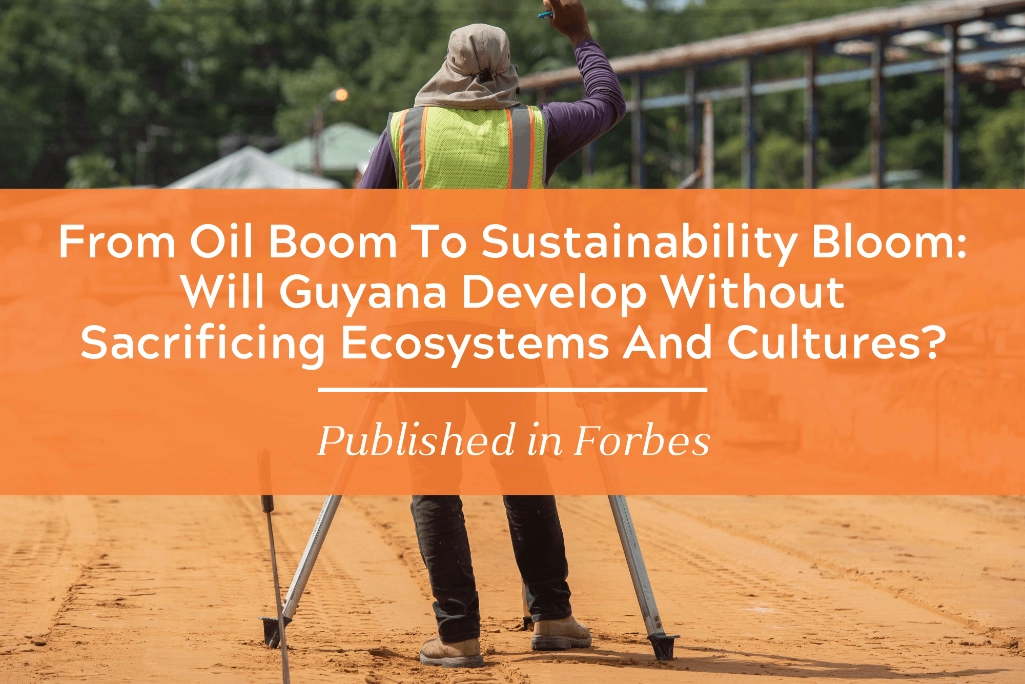
Hitting the Economic Jackpot
Guyana, a largely forested country with scattered rural communities in South America’s northeast, hit the economic jackpot in 2015. An oil company announced it had discovered significant amounts of the resource offshore. Since then, exploration has uncovered some 11 billion barrels buried below the country, which will generate an estimated $10 billion annually for the Guyanese government.
The deluge of money and investments is leading to development – most notably, the Guyanese government is constructing a new 345-mile highway to connect the capital of Georgetown to Lethem, a town that borders Brazil in Guyana’s southwest. Its route, built atop an existing dirt path called the Rupununi Road, carves through ancient wetlands and hundreds of thousands of acres of forest. Many residents are excited about the promise of more jobs, more tourism and a high-speed artery to shuttle people between towns for food, education and commerce. The new infrastructure will also bring investments and trade opportunities from neighbor Brazil, which will gain access to the port at Georgetown.
But experts say Guyana’s highway-building project is quickly approaching a fork. Taking it in one direction could put the country on a path to robust and equitable sustainable development that brings along Indigenous and poor rural communities while protecting critical ecosystems. The other way would be a return to destructive development projects that South America has seen many times before-where infrastructure helps only a few extract natural resources while leaving communities destitute and natural areas in ruins. What the project needs, local activists and leaders say, are plans for sustainably and collaboratively incorporating the new infrastructure. No local experts working in Guyana wanted to be named in this story, citing the sensitivity of ongoing development discussions.
“Guyana has the opportunity to demonstrate to the rest of the world that it can develop its country economically while protecting the unique cultural value of its local and indigenous people and preserving its extraordinary biodiversity,” said Sara Scherr, CEO of EcoAgriculture Partners, a sustainable development and conservation nonprofit organization.
She said officials must work now to avoid what is known as the resource curse, where the abundance of a natural resource actually leads to worse development outcomes, undermining other economic sectors and creating significant social, economic and political problems. To see that situation play out, one needs only to look at nearby Ecuador, where harmful oil exploration led to murder, groundwater contamination and poisoning deaths in surrounding communities. Not only did regions suffer from extreme human and environmental harms, the country’s economy is still in debt.
Continue reading the story at Forbes.com.
This story was written by EcoAg’s Communications Associate, Brianna Van Matre. The full story was originally posted on Forbes EQ Brand Voice on March 22, 2024.