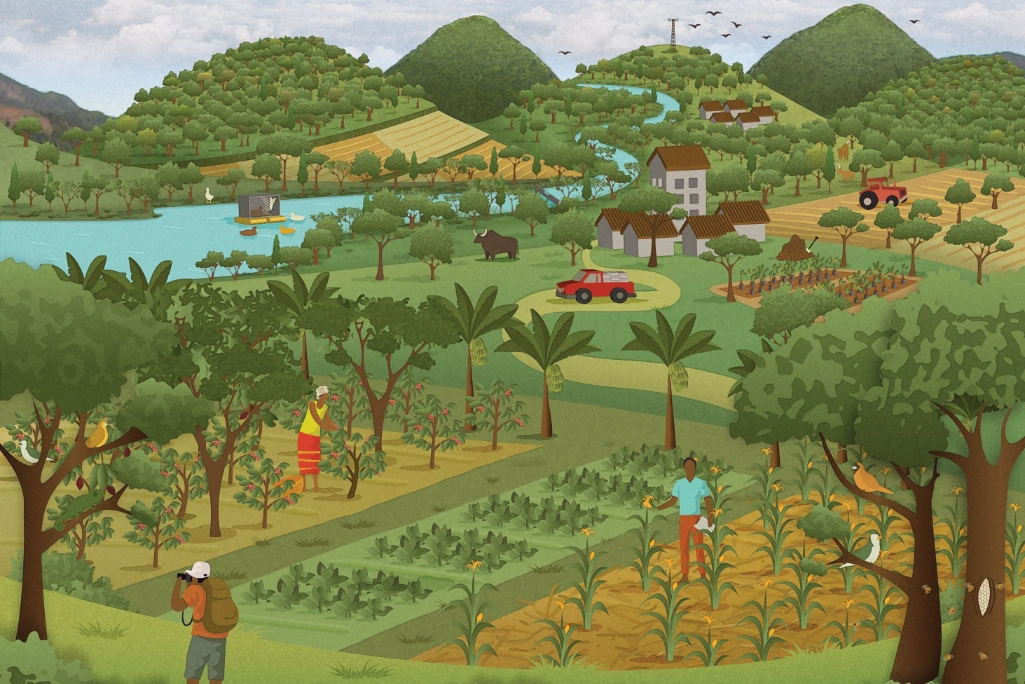
From the small coffee plantations of Huancayo, Peru, to the bustling markets of Ouagadougou, Burkina Faso, residents are leveraging the transformative power of Integrated Landscape Management (ILM).
This collaborative approach to guiding a region’s land use and development improves community well-being and environmental health everywhere people employ it.
To help more people learn how ILM can support their communities, EcoAgriculture Partners is collaborating with global nonprofit Rikolto to deliver a series of training workshops in 16 landscapes worldwide.
Rikolto, which works with farmer organizations and food supply chain stakeholders to improve livelihoods and access to nutritious food, manages three global programs: Sustainable Rice, Sustainable Cocoa & Coffee, and Good Food 4 Cities. Each focuses on instituting inclusive and equitable business practices that promote sustainable landscape management.
The joint EcoAg-Rikolto program aims to hone community leaders’ skills in establishing partnerships with stakeholders, ultimately leading to more resilient and sustainable landscapes. EcoAg and Rikolto staff from landscapes across Africa, Southeast Asia, and Latin America came together in October to develop these skills and apply their work in the landscape context.
Building Adaptable Training for Any Landscape
The workshop aims to acquaint audiences with ILM and help further its mission to strengthen landscape partnerships, improve livelihoods, and protect ecosystems.
The first sessions introduced participants to ILM and helped them see their localities through the lens of large-scale land management and the natural processes and human activities there that tie it together. They also discussed the importance of partnerships and how to collaborate with multiple stakeholders in a landscape.
“During the sessions, I was struck by how the Rikolto team placed partnerships at the center of their work,” said Derek Caelin, product manager of Terraso, the digital ILM platform being developed for the EcoAg-convened 1000 Landscapes for 1 Billion People (1000L) initiative. This open-source information-sharing platform will be critical in landscape partnerships’ work. “At some level, most sustainability organizations recognize the value of collaboration, but it’s easy to see that Rikolto treats bringing together diverse stakeholders as foundational to every other action.”
The current capacity-building partnership between Rikolto and EcoAg is the most recent in a history of collaboration, as the two organizations previously joined forces to organize an influential Mesoamerican landscapes dialogue in 2018 as part of the EcoAg-led Landscapes for People, Food, and Nature initiative.
“I am excited about the opportunity to co-create and support this learning process with EcoAgriculture Partners,” said Mariela Wismann, director of Rikolto’s Good Food 4 Cities program in Latin America. “It is key to learn together and to strengthen the institutional working approach based on collaboration and articulation of different stakeholders with a common vision. The integrated management perspective is crucial to facing the challenges of our agri-food systems.”
Experience Leads to Impactful Change
The partnership’s training curriculum delivery is now well underway, and sessions have already been held to introduce ILM and build and engage diverse partnerships. These and upcoming sessions are tailored from capacity-strengthening learning modules originally developed through 1000L, a global collaboration to sustain and restore ecosystems, build rural prosperity, and confront climate change through landscape partnerships. The lessons learned from this project will improve the content, eventually benefiting hundreds of landscapes worldwide.
Programs like this EcoAg-Rikolto collaboration are crucial to confronting humanity’s myriad crises. When stakeholders throughout a landscape unite to create innovative solutions, they can effectively address poverty, climate change, biodiversity loss, and many other issues. Problems do not exist in a vacuum: Changemakers must address the interaction between humans and their environments, their cultural experiences, and how different stakeholders can meet their individual goals while complementing one another’s work.
EcoAg appreciates Rikolto’s support and dedication to implementing collaborative, integrated solutions for livelihoods and ecosystems.