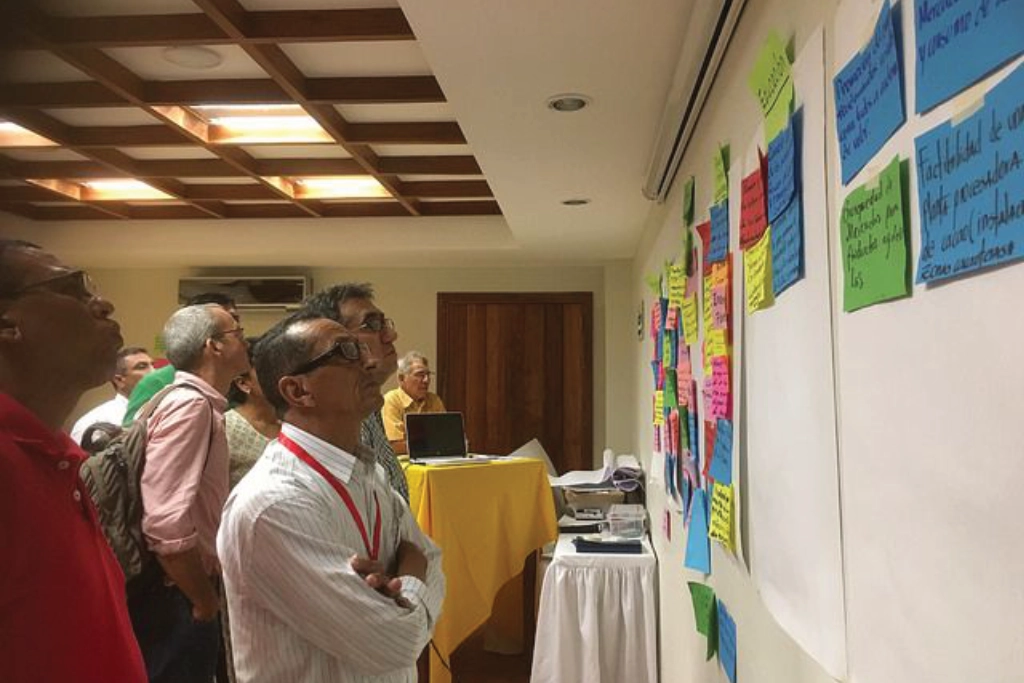
Nicaraguans from the Southern Caribbean Coast came together to define their own vision for sustainable management of the landscape.
Laguna de Apoyo, Municipality of Catarina, Department of Masaya, Nicaragua – On September 18-21st, 32 participants came together here to attend an intensive Course for Leaders in Integrated Landscape Management, hosted by Solidaridad, EcoAgriculture Partners, and the International Center for Tropical Agriculture (CIAT). Participants arrived from the RACCS region of southeastern Nicaragua (RACCS, Región Autónoma de la Costa Caribe Sur, or the Southern Caribbean Coast Autonomous Region of Nicaragua), and other regions with distinct landscapes and contextual challenges, such as Lago de Ápanas in Jinotega (northwestern Nicaragua). The objective of the course was to facilitate dialogue and empower diverse stakeholders who live within the RACCS landscape to define their own vision for sustainable management of the landscape, and provide them the necessary tools and management framework to achieve it.
Participants in this course were dynamic and highly skilled, and brought unique perspectives from diverse backgrounds including civil society (agricultural and social NGOs, academia, community organizations, cooperatives, and young emerging community leaders), the private sector (small- and large-scale agriculture/livestock, cacao, and palm oil producers and industrial processing), and the public sector (local and RACCS regional government).
Opportunities for Integrated Approaches in the RACCS
The RACCS region of Nicaragua is the second largest area in Nicaragua, with 27,407 km² (10,582 sq miles) under autonomous regional governance by 47 councilors, and regional representation in Nicaragua’s National Assembly. RACCS is a highly diverse region, both agroecologically (coastal fisheries and mangroves, lowland annual agriculture, cattle and dairy farming, palm-oil and upland cacao production), and culturally. A coastal area vulnerable to hurricanes and the negative impacts of climate change, RACCS is home to a diversity of ethnicities: the Garifuna, Creole, Mestizo, and numerous indigenous communities who speak languages that are considered severely endangered (Rama, Miskito, and Sumo). The cultural heritage of these ethnic groups is rooted in the natural resources of the region. As such, RACCS encompasses the political, social, and ecological interests and complexities that Integrated Landscape Management is best positioned to address.
Following the successful June 2017 launch of Solidaridad’s PASOS program in Bluefields and El Rama in RACCS, this four-day workshop focused on how to design collaborations for Integrated Landscape Management, leadership and facilitation between multiple actors with distinct interests and cultures. We clarified key definitions and characteristics of Integrated Landscape Management, and used the objectives of sustainable development goals to frame collaborative plans of action in RACCS. We introduced participants to tools and resources for collaboratively analyzing the RACCS landscape through different lenses (e.g. ecological, agricultural, economical, cultural, political), to understand the tendencies and patterns in the region, and then practiced facilitation techniques for engaging in difficult conversations and managing conflict with diverse representatives of distinct interests. The workshop catalyzed the process for opening and facilitating dialogue across sectors, and initiating working groups for collaborative planning and action.
Learning within the Landscape
Participants had the opportunity to go on a guided ecological tour/hike around the Laguna de Apoyo, with stops to talk with representatives from MARENA and the Municipality of Catarina, and a visit to the Technical College Emprendedora that trains at-risk youth in sustainable agricultural production, and the GAIA Biological Station. This field trip gave the participants the opportunity to observe the overall structure of the landscape, and begin to understand the full context of the Laguna de Apoyo and socio-ecological flows. The participants then practiced using the Landscape Performance Scorecard tool for collaborative analysis of this unfamiliar landscape, with supportive guidance from Solidaridad-Nicaragua, CIAT, and EcoAgriculture Partners. They seized the opportunity to discuss the utility of the scorecard and other ILM tools to evaluate and monitor their own more familiar landscape in RACCS.
The course created dynamic space and time for participants to identify a collective vision for Integrated Landscape Management in RACCS, and to strategize and agree upon priorities for arriving at their collective vision. Participants proposed and volunteered their ongoing participation in multi-sector working groups. Working groups took time to connect, discuss, and brainstorm activities to catalyze Integrated Landscape Management in RACCS.
Transforming Vision Into Action
We encouraged course participants to facilitate dialogue and knowledge sharing within and between Nicaraguan regions. There was great enthusiasm in the formal and informal exchange of experiences and networks amongst fellow colleagues and participants from the region, both in and outside of structured course time. PASOS Nicaragua established communication platforms to keep everyone connected and move the momentum forward to achieve the progressive goals the participants set out for themselves. Participants were particularly interested in diving deeper into jurisdictional certification, learning how to better work with businesses and the private sector, and how to creatively finance Integrated Landscape Management. The hope is with the vision, strategy, and priorities set in these four days, the working groups can self-organize to take advantage of the knowledge and momentum created during the workshop to explore deeper the areas they need to effectively propose and organize for Integrated Landscape Management, and develop a clear, collaborative plan for action to address sustainable development and natural resource management relevant to their communities.
With strong representative leadership demonstrated during the workshop, we have no doubt they have the capacity to achieve their vision! EcoAgriculture Partners looks forward to following their progress and supporting them in any way they might need. Watch this space for new developments around Integrated Landscape Management in RACCS.