
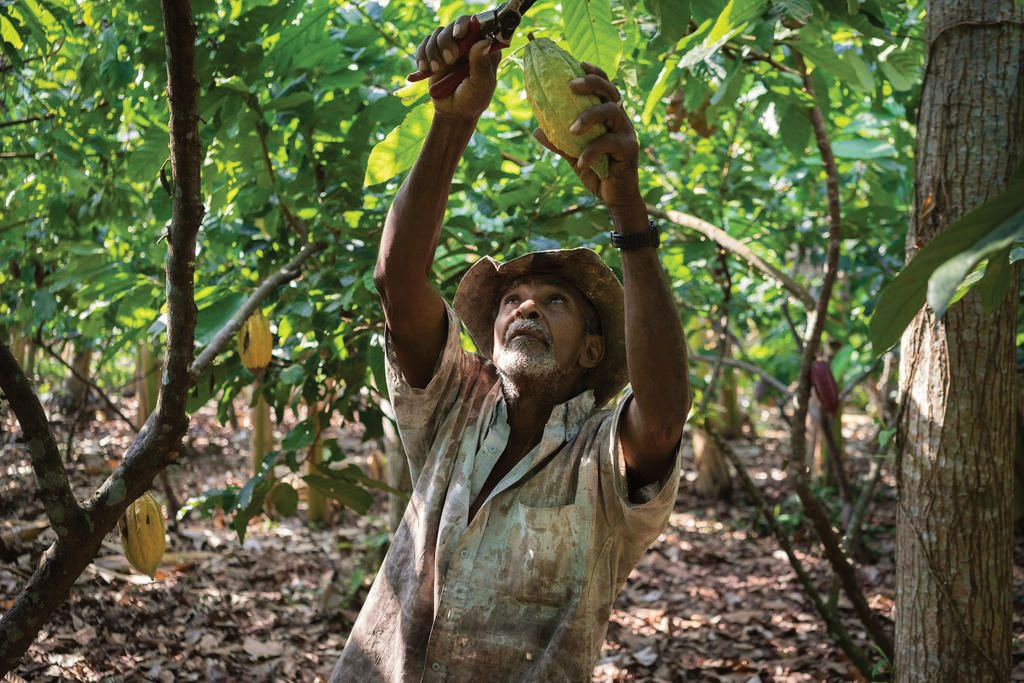
Working together with the PASOS multi-stakeholder platform in northern Honduras, we’re refining a complete toolset for knowledge-driven Integrated Landscape Management.
In 2016, the Solidaridad Network launched the PASOS program (Paisajes Sostenibles, or “Sustainable Landscapes”) in the Zona Norte of Honduras to extend their existing work on sustainable palm oil into an Integrated Landscape Management (ILM) approach for sustainability and social inclusion. EcoAgriculture has been supporting this effort in various ways, including through a landscape assessment exploring local conditions, activities and ambitions; staff training, and a leadership workshop with landscape leaders.
Modeling Future Landscape Scenarios
In June 2017, following a dynamic workshop in collaboration with Solidaridad-PASOS and the Dutch Environment Assessment Agency (PBL), a wealth of landscape level data from Zona Norte was collected, processed, and analyzed using GIS to create a series of modeling scenarios for meeting the Sustainable Development Goals (SDGs) at the landscape scale. These models depict current trends and potential outcomes if stakeholder-identified landscape ambitions are/not met by 2030. Cross-referencing these models with SDG targets can then provide national government officials with a view to how much the local effort can contribute to national ambitions for achieving the SDGs.
During that workshop in early June, both Solidaridad and landscape stakeholders in the Zona Norte of Honduras identified the need for a tool that tracks progress towards PASOS Honduras’ specific goals, and the SDGs more broadly, across the multiple dimensions of the landscape. The wealth of landscape level data that was collected and evaluated enabled the establishment of a robust baseline on the current status of the landscape, against which stakeholders’ own conservation and sustainable development goals for the landscape can be tracked. Thus, the impetus to co-create a Landscape Performance Tool was ignited.
Designing the landscape performance tool, together with PASOS stakeholders
On January 18 and 19th, 2018, approximately 20 representatives of stakeholders from public, private, and civic sectors across the Zona Litoral del Norte de Honduras gathered in Tela to participate in a 1.5-day workshop: Diseño de la Herramienta para Evaluar el Desempeño de Paisajes Sostenibles, which I facilitated, supported by my colleague Seth Shames, EcoAgriculture Partners’ Director of Policy and Markets along with Omar E. Palacios Bardales, Dubail Rosa, and Flor Tejada of Solidaridad-PASOS Honduras.
The workshop was designed to:
- introduce the (prototype) Landscape Performance Assessment Tool (v1.0), built upon the PBL work conducted in early 2017;
- solicit initial feedback about the format, accessibility, and utility of the tool;
- elaborate upon criteria for the landscape ambitions identified in the Landscape Leader workshop in 2017;
- revise existing and identify new indicators most useful to evaluate baseline data (and later for monitoring and evaluating the progress of the landscape to achieve its stated ambitions);
- identify missing data that would be needed to be accessed or collected;
- identify sources of existing data at the municipal, regional, or national levels and the institutions responsible for collecting those data;
- and identify next steps and recommendations for improving the tool.
The participants self-organized into four groups aligned with the four key components of an integrated landscape: i) Ecosystem Health, ii) Agricultural Production, iii) Livelihoods & Wellbeing, and iv) Institutional Capacity. Each group examined their component within the tool to review the ambitions, criteria and indicators, using the SDGs as a reference to guide the process for discussion. Then, each group reflected upon and broadly discussed the overall format of the tool (accessibility, utility, etc.), challenges they foresee using the tool, and opportunities for using the tool to achieve ambitions in the Zona Norte landscape. Lastly, each group brainstormed sources of potential datasets from national, regional, and municipal levels, and when possible specified who would be the appropriate point-person within that institution to contact, and who within the working group had a personal relationship that could request the datasets.
Participation was highly engaged and thoughtful, providing excellent feedback for improvement of both the tool and the introduction to the tool. Perhaps most importantly, the majority of the datasets identified may be accessed directly through the social networks of the stakeholders, highlighting again the high value of social capital in lieu of an excess of financial capital in landscape-level initiatives.
Watch this space
We look forward to incorporating the stakeholder’s valuable feedback into v2.0 of the prototype Landscape Performance Tool, and our continued engagement in this unique socio-ecological zone of northern Honduras in the year to come. If the pilot of this tool works well in Honduras, we are excited to see how it can be applied in other landscape initiatives using ILM processes for decision-making.
Stay tuned for the future unveiling of the Landscape Performance Tool, and to learn how you can use it in your landscapes to improve multi-stakeholder decision-making and management plans to achieve the SDG ambitions at the landscape-scale by 2030.