
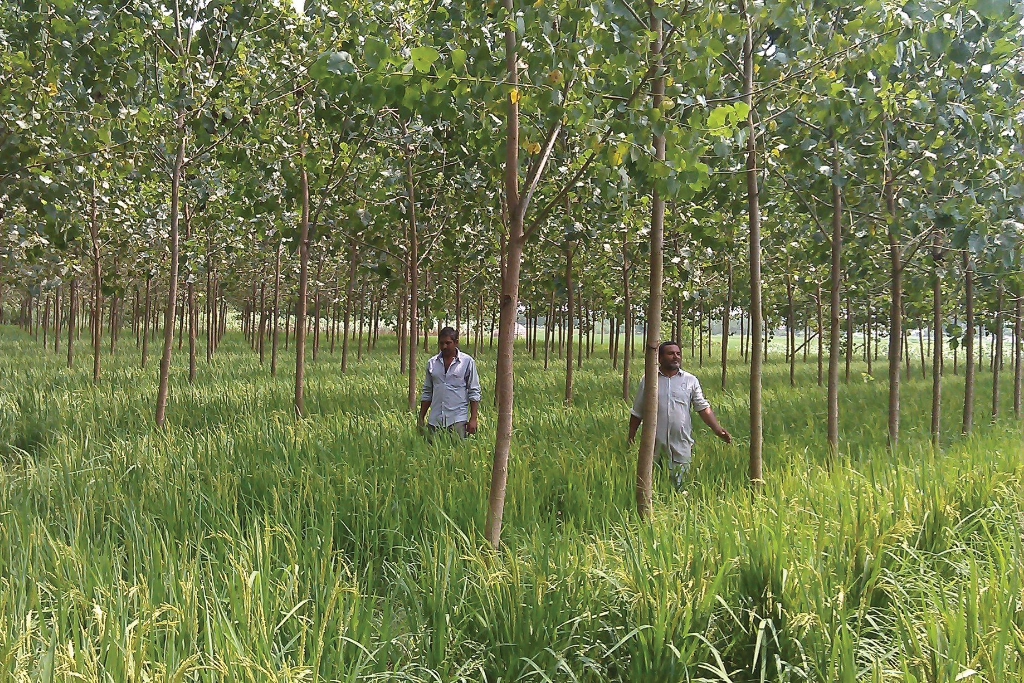
In the context of climate change, growing populations, and economic transformation, agroforestry stands to play a vital role in transitioning landscapes to meet production and protection needs.
Landscapes that use agroforestry, the deliberate combination of woody perennial plants with annual crops and/or livestock, contribute to the full range of goods and services from agriculture and natural resources needed for social and ecological sustainability.
A key to realizing agroforestry’s potential in sustainable landscapes is to recognize diverse niches for agroforestry across fields, farms, grasslands, and forests, and plan farm and ranch-level enterprises with the larger agroecosystem in mind. A corresponding component is to generate the incentives needed to practice agroforestry by a broad and spatially contiguous spectrum of land managers. Both require the coordination of diverse organizations in farm and landscape-level planning and management.
ILM a valuable framework for coordinating the development of agroforestry landscapes
ILM offers a strategy for scaling up agroforestry by mobilizing collaborative efforts among multi-sector stakeholders. By combining interests and expertise in the production and marketing of different crops and meats with those in soil, water, forest and grassland conservation, leadership and financial resources can be mobilized to unlock the long-recognized potential of agroforestry.
At the Fourth World Congress on Agroforestry, in Montpellier, France in May, Louise Buck presented preliminary findings from a study entitled “Scaling-up agroforestry to transform landscapes, with examples from Ecuador and Northeast USA“. The study demonstrates ways that ILM has been applied in agroforestry initiatives in three diverse landscapes: the Amazon Production Transformation Agenda (ATPA) project of the Ecuadorian Ministry of Livestock and Ministry of Environment, the Chocó-Andean Bio-Corridor in Ecuador, and the Nut Tree Based Agroforestry initiative in New York.
The three agroforestry initiatives that provide cases for the study include a government-led approach (ATPA), a civil society and international NGO led approach (Chocó-Andean Bio-Corridor), and a value-chain led approach (Nut Tree Agroforestry). Each of these initiatives includes indigenous peoples’ lands and organizations.

Sacha Inchi (Plukenettia volubilis) is a valuable understory crop in the Amazonian agroforestry system of the ATPA project. The young fruit is green. When it turns brown, it is ready to harvest. The fruit is rich in Omega 3s, making it nutritious and also prized for use in cosmetics.
Highlighting levers of change for scaling up agroforestry
The analysis highlights the levers of change that are proving particularly valuable in advancing the scaling-up of agroforestry. Notable levers include a spatial planning tool that links the design of farm-scale agroforestry practices within a larger landscape transformation strategy that is shared by Ministries of Agriculture and Environment. Another has been a widely shared community-grounded vision for a bio-economy based alternative to extractive industry. A third notable lever has been a farmer-driven program of collaborative action research designed to generate practical answers to questions needed to stimulate investment in cooperative processing facilities for agroforestry products. These and other innovations stem from leadership that recognizes and harnesses the value of multi-sector collaboration around a place of common interest.
The study illustrates the value of the ILM framework in teasing out diverse factors that are contributing to agroforestry scaling, as well as factors inhibiting it that need to be unblocked. In giving shape and specificity to the constellation of incentives that must work synergistically to reap the multiple benefits of landscape-scale agroforestry, the study offers evidence for the high potential of practicing ILM for bringing agroforestry to scale.