Integrated Landscape Management: The Means of Implementation for the Sustainable Development Goals
Region of Focus
Overview
Required: integrated approach to sustainable development
Sustainable Development Goals related to poverty eradication, sustainable agriculture, food security and nutrition, water and sanitation, health and population dynamics, sustainable cities and human settlements, ecosystems and biodiversity, climate adaptation and mitigation, clean power generation, social stability and security, and sustainable production and consumption are NECESSARILY linked.
To simultaneously achieve multiple SDGs, communities and businesses will need to find new ways to invest in and manage their land and water resources to secure the full range of goods and services needed from their landscapes.
Realizing multiple outcomes simultaneously
Integrated landscape management ensures that by managing the underpinning natural resource base and ecosystem services in a coordinated way, societal needs can be met in the short and long term. Over the past decade, there has been remarkable growth in integrated landscape management activities on the ground and increased support by policymakers, businesses, and leaders to include ILM as a key component of their sustainable development portfolios. Countries like Colombia, Ethiopia, and Rwanda are leading the way in adopting more integrated, participatory and adaptable approaches to sustainable landscape management to achieve ambitious national development goals.
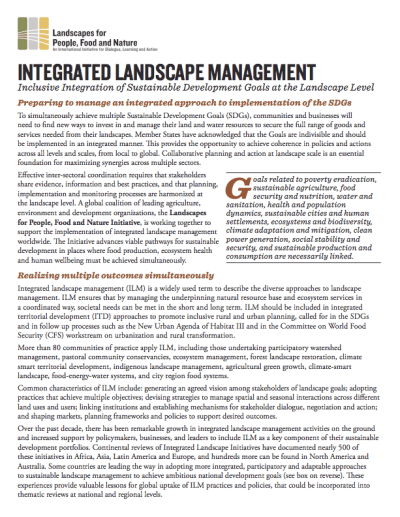
Download this 2 page brief outlining the approach and its importance.
Media Type
Language
Published
23 September 2015
Authored by
Millennium Institute, GIZ, UNEP, Biodiversity International, World Agroforestry Centre, CIFOR, FAO, International Model Forest Network, World Resources Institute, CATIE
License
Creative Commons - BY - NC - ND
License
License