
Ten principles for a landscape approach to reconciling agriculture, conservation, and other competing land uses
Region of Focus
Overview
What is the Landscape Approach?
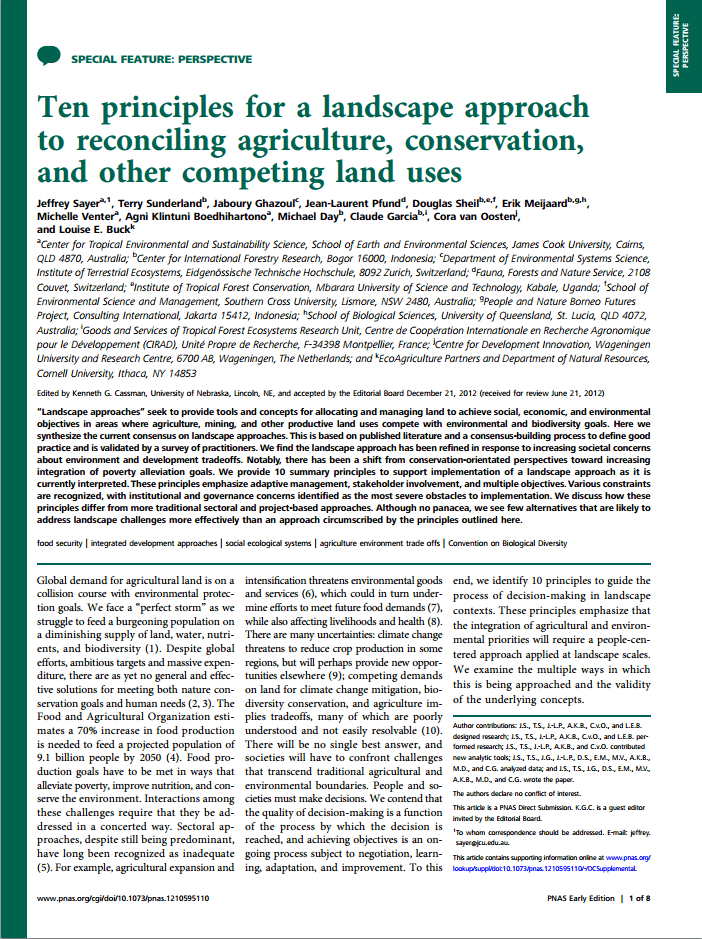
“Landscape approaches” seek to provide tools and concepts for allocating and managing land to achieve social, economic, and environmental objectives in areas where agriculture, mining, and other productive land uses compete with environmental and biodiversity goals.
This article synthesizes the current consensus on landscape approaches, based on published literature and a consensus-building process to define good practice, and finally validated by a survey of practitioners.
Refined in Response to Increased Concern for Sustainable Development
The paper finds the landscape approach has been refined in response to increasing societal concerns about environment and development tradeoffs. Notably, there has been a shift from conservation-orientated perspectives toward increasing integration of poverty alleviation goals.
The paper outlines the 10 key principles of a landscape approach as it is currently interpreted. These principles emphasize adaptive management, stakeholder involvement, and multiple objectives. Various constraints are recognized, with institutional and governance concerns identified as the most severe obstacles to implementation.
Media Type
Language
Published
21 May 2013
Authored by
Boedhihartono Klintuni Agni, Buck Louise, Ghazoul Jaboury, Meijaard Erik, Oosten van Cora, Pfund Jean-Laurent, Sayer Jeffrey, Sheil Douglas, Sunderland C.H Terry, Venter Michelle
License
Open Access Published online before print. May 21, 2013, doi:10.1073/pnas.1210595110 PNAS May 21, 2013 vol. 110 no. 218349-8356
License
License