
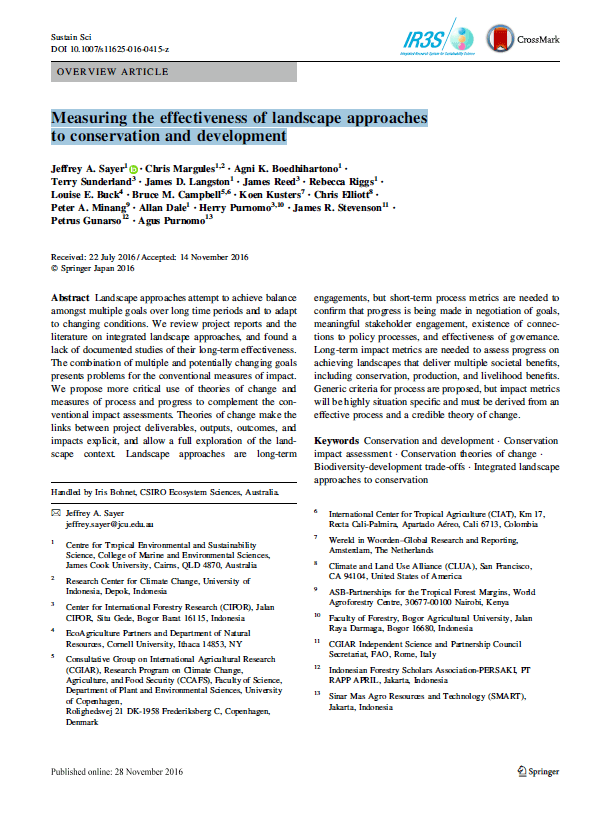
Measuring the effectiveness of landscape approaches to conservation and development
Region of Focus
Overview
Development professionals are often called on to justify calls for increased investment in multi-stakeholder processes, integrated and inclusive adaptive management planning, and long-term governance structures. But evidence of the impact of landscape approaches is lacking. Lack of evidence of impact does not mean lack of impact. A wide variety of factors contribute to this evidence gap. The traditional data and metrics used to measure conservation or development success are of insufficient. The combination of multiple and continually shifting goals presents problems for the conventional measures of impact.
Landscape approaches are by nature and necessity long-term engagements, with multiple and shifting goals, while monitoring and measurement tools and timelines are typically short-term. This new study addresses this major challenge for integrated landscape management and its advocates.
Abstract
Landscape approaches attempt to achieve balance amongst multiple goals over long time periods and to adapt to changing conditions. We review project reports and the literature on integrated landscape approaches, and found a lack of documented studies of their long-term effectiveness. The combination of multiple and potentially changing goals presents problems for the conventional measures of impact. We propose more critical use of theories of change and measures of process and progress to complement the conventional impact assessments.
Theories of change make the links between project deliverables, outputs, outcomes, and impacts explicit, and allow a full exploration of the landscape context. Landscape approaches are long-term engagements, but short-term process metrics are needed to confirm that progress is being made in negotiation of goals, meaningful stakeholder engagement, existence of connections to policy processes, and effectiveness of governance.
Long-term impact metrics are needed to assess progress on achieving landscapes that deliver multiple societal benefits, including conservation, production, and livelihood benefits. Generic criteria for process are proposed, but impact metrics will be highly situation specific and must be derived from an effective process and a credible theory of change.
Media Type
Language
Published
28 November 2016
Authored by
Buck Louise, Boedhihartono Klintuni Agni, Campbell M. Bruce, Dale Allan, Elliott Chris, Purnomo Agus, Purnomo Herry, Gunarso Petrus, Kusters Koen, Langston D. James, Margules Chris, Minang Peter, Reed James, Riggs Rebecca, Sayer Jeffrey, Stevenson R. James, Sunderland C.H. Terry
License
© Springer Japan 2016 Sayer, J.A., Margules, C., Boedhihartono, A.K. et al. 2016. Measuring the effectiveness of landscape approaches to conservation and development. Sustain Sci. doi:10.1007/s11625-016-0415-z
License
License