
We need insects to feed ourselves, but conventional agriculture is driving them to extinction.
Earth Day is April 22nd. This year the theme is Protect Our Species, with a focus on bees and insects, among other threatened species. Here are 5 facts about insects and agriculture that will hopefully convince you to get involved.
1. Insect diversity is amazing, and critical
Insects represent over half of all known living organisms, and potentially constitute 90% of all animal life forms. So they play a vast and incalculable role in a healthy and functioning biosphere, in every ecosystem. They are especially important in agriculture: they are needed to pollinate at least 1000 different common food, fiber and medicinal plants around the world. Bees alone (just one subgroup of insects) are responsible for pollinating about one-third of the world’s food supply.
2. Insects are dying off at terrifying rates
Emerging facts pointing to a collapse in insect populations are very alarming. One recently published major meta-analysis in Biological Conservation found over 40% of insect species are threatened with extinction, and a 2.5% annual decline in insect abundance. At that rate, all insects could be gone within a century! The declining population of food pollinators, like wild bees and butterflies, threatens three quarters of the world’s food crops and their associated supply chains. The irony? The study also pointed to the culprit of the collapse: intensive agriculture.
3. Agriculture is the culprit, but why?
First and foremost, intensive agriculture leads to dramatic simplification of ecosystems; from diverse grasslands or forests with lots species providing year round niches, structure and protection, food sources, and nesting possibilities to desolate wastelands of a single species blooming at a single time of year. “Unless we change our ways of producing food, insects as a whole will go down the path of extinction in a few decades,” write the authors of the Biological Conservation meta-analysis. “The repercussions this will have for the planet’s ecosystems are catastrophic to say the least.”
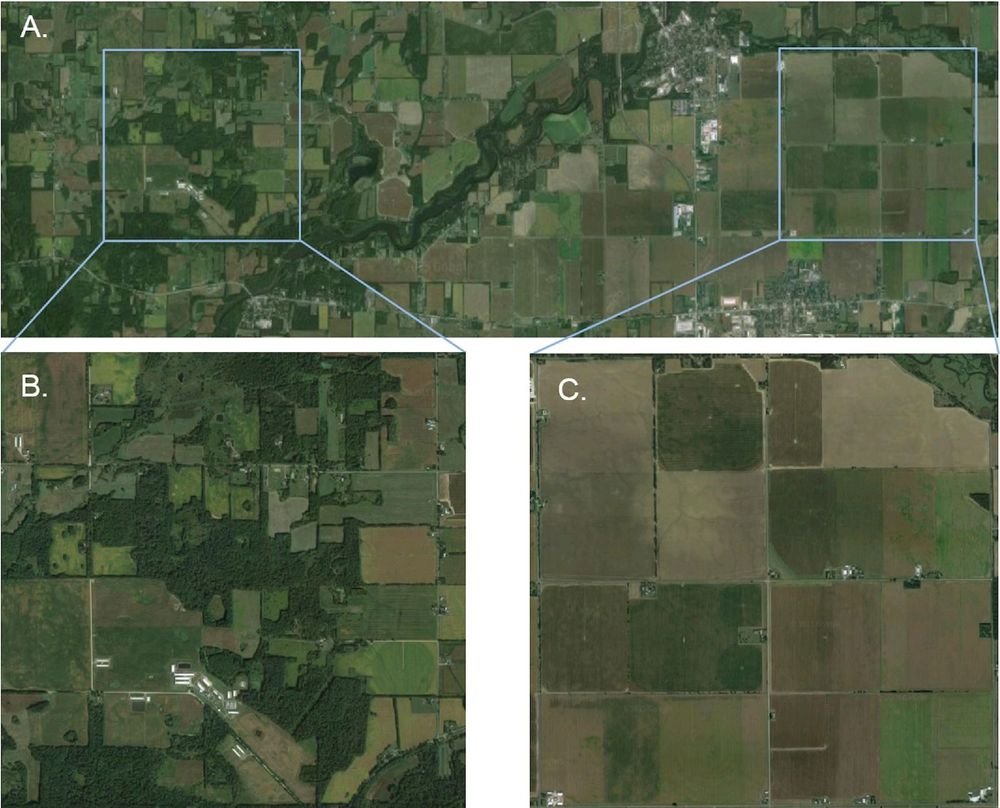
Typical agricultural landscape in southern Michigan, USA showing, (A) gradient in agricultural landscape complexity. (B) Expanded view of relatively complex landscape with prominent woodlots, fencerows and wooded riparian areas. (C) Expanded view of simplified landscape on higher productivity soils. Note the rounded field corners and centrally located irrigation risers in many fields indicative of center-pivot irrigation. Imagery © 2016 Google. Image and caption from Landis, 2017.
Source: Landis, 2017
4. Decreases in insect populations cost us more than just pollination services
Landscape homogeneity, essentially an indicator of the average size of monoculture fields within a given area, is directly correlated with decreased species diversity and also decreased functional diversity, that is, the number of different ecosystem services provided. This means that as we simplify our agricultural landscapes into increasingly larger and larger farms growing fewer and fewer crops (the overwhelming trend of the past 70 years), we are losing more and more of the value ecosystems provide. This includes water-holding capacity, erosion control, pest control and carbon storage, along with pollination.
5. We can still do something about it.
Studies have shown that organic farming increases insect density and diversity, and organic farms have an average 30% higher species richness than conventional farming systems. Planted windbreaks reduce pesticide runoff by 40-100%, and have been shown to help more of the hive successfully overwinter. Increasing pollinator diversity improves yields on small farms, which produce most of the food for the world’s poor, by a median of 24%.
The challenge, as entomologist Douglas Landis writes: “To stem the loss of function will require actions that alter landscape structure at scales larger than individual farms and suggest that mechanisms for planning and coordination will be required.”
Stay tuned for more on the insect collapse and what you can do about it between now and Earth Day.
Donate to support transformation of agricultural landscapes into healthy places for people and insects!